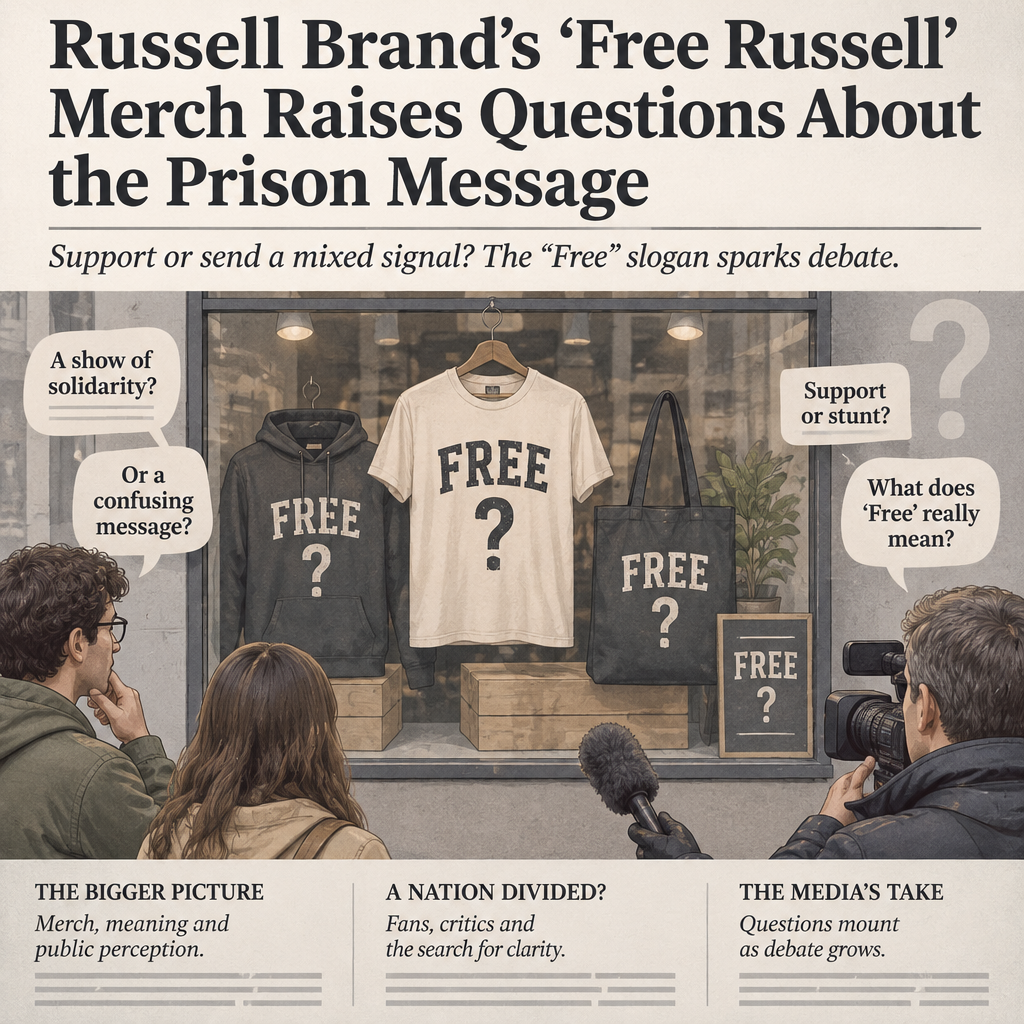
The merchandise makes a legal story louder. Reborn Wellness is described as listing “Free Russell” shirts and a hat as fundraiser apparel, while a report...
Russell Brand’s “Free Russell” Merch Raises Questions About the Prison Message
The merchandise makes a legal story louder. Reborn Wellness is described as listing “Free Russell” shirts and a hat as fundraiser apparel, while a report links the sale to a message attributed to Russell Brand after sentencing and a subsequent investigation. But the claims need separating from what is documented. What is confirmed?
Here’s the central distinction. A store listing, a fundraising label, a message attributed to a prisoner, and a criminal judgment are four separate things, and evidence for one does not automatically establish the others. Keep them separate. The report also says Brand was convicted of one count of rape and three counts of sexual assault and sentenced to 10 years and six months, but it provides no court, date, or judgment to verify that outcome. The Reuters report and Crown Prosecution Service release cited below concern the earlier charge stage; they do not establish the later verdict or sentence described here. That gap matters.
What Is the “Free Russell” Merchandise Story?
It is a reported fundraising merchandise campaign tied to Russell Brand’s public defence of his imprisonment. The account says Reborn Wellness, a company associated with Brand’s wellness brand, listed T-shirts and a hat bearing “Free Russell Brand” or “Free Russell,” under a section labelled “Fundraiser Apparel.” That is the basic claim. The page description reportedly states, “Silenced for speaking out against injustuce [sic] and corruption.” The misspelling is preserved here because it appears in the reported wording; it is not evidence about the campaign’s accuracy or purpose.
The statement does more than sell a slogan. It frames Brand as a person being punished for speaking out, a claim that competes with the criminal-case account and may steer buyers toward a particular interpretation before they have seen court documents. Marketing language is not a court finding. Nor is a shirt proof of censorship. The distinction is obvious, but it gets blurred fast when celebrity coverage compresses a legal record, a family message, and a storefront into one dramatic headline.
The other part of the story is a message attributed to Brand and shared by Laura Brand. Its reported wording was: “As you know, I am not guilty for the offences I have been jailed for, so something strange is happening.” That line is a denial, not a judgment, and the report says the post prompted scrutiny because of restrictions on prisoners’ public statements. What rule applied, who opened the investigation, and whether it resulted in any action are not detailed in the account.
That missing detail is not a small footnote. Reuters’ earlier coverage of the case and the Crown Prosecution Service’s announcement describe charges, which are legally distinct from a conviction; neither link verifies the later outcome asserted in the merchandise report. I would not turn an unlinked claim into a settled fact just because it appears in a confident paragraph. Court records matter. So do the people affected by the case, whose dignity should not be reduced to props in a sales pitch or a fan campaign.
Core Details and Context
The story has two public-facing parts: apparel and speech. The merchandise makes a political-sounding claim about silencing and corruption, while the reported prison message asserts innocence and suggests something is wrong. Both are designed to shape the audience’s understanding. Neither, by itself, answers the legal questions.
- The products: The account describes T-shirts and a hat with “Free Russell Brand” or “Free Russell” printed on them. It does not give prices, product quantities, sales totals, or a direct product link.
- The fundraiser label: The store section is said to call the products “Fundraiser Apparel.” That label does not say how much money is raised, who receives it, or whether expenses are deducted.
- The product copy: The description reportedly uses the word “Silenced” and refers to “injustice” and corruption. Those are the seller’s framing, not findings by a court or an independent inquiry.
- The prison message: The report attributes a denial to Brand through Laura Brand’s post. It does not include the full post, the date, or any official decision about whether the message broke a rule.
- The legal status: The report states that Brand was convicted and sentenced. The citations in this article do not verify that claimed later result; a named court and judgment are needed to establish it.
Here’s the kicker. A fundraising page can be a commercial product page, a political statement, a loyalty signal, and a source of money all at once, but each role deserves its own questions. A buyer should be able to tell where proceeds go, whether the fundraiser has a target, and who administers it. No such figures are reported here. That means readers cannot calculate the campaign’s reach or judge whether the word “fundraiser” describes a charitable effort, support for a legal defence, or something else.
The phrase “silenced for speaking out” also asks readers to accept a cause-and-effect claim. It implies a person was punished because of what he said, rather than because of a criminal proceeding. That could be true in some contexts, but a slogan cannot prove it in this one. The relevant evidence would include the precise prison rule, the official reason for any inquiry, and the outcome. The report supplies none of those documents. Ask for the paperwork.
The reported warning about prisoner statements needs similar care. The account says a government spokesperson reminded people that prisoners are barred from making statements that can injure victims. It does not provide the spokesperson’s exact statement, identify the specific rule, or link to an investigation notice. The Prison Rules 1999 are a useful primary reference for the rules governing prisons in England and Wales, but a general rulebook does not establish that a particular person breached a rule or that an investigation was opened.
Timeline: What the Report Says Happened
The sequence below follows the order described in the account, not a verified court chronology. Dates are not reported. That matters, because legal milestones cannot be reconstructed reliably from a story that provides no dates or linked documents.
- The store listing appears. Reborn Wellness is reported to have displayed shirts and a hat in a “Fundraiser Apparel” section. The slogans read “Free Russell Brand” and “Free Russell.” No sales data or donation records are supplied.
- The product description sets the tone. The copy reportedly claims Brand was “Silenced for speaking out against injustuce [sic] and corruption.” That is a seller’s assertion. It does not identify who supposedly silenced him or what evidence supports the accusation.
- A message is attributed to Brand. Laura Brand reportedly shared a statement in which Russell Brand said he was not guilty of the offences for which he was jailed and that “something strange is happening.” I read that as a denial and a challenge to the process, not proof of either innocence or misconduct by authorities.
- The message reportedly draws official scrutiny. The account says an investigation was launched after the post, and attributes a warning about prisoner statements to a government spokesperson. It does not name the investigator, quote a formal notice, specify a rule, or report a finding.
- The report gives a conviction and sentence. It says Brand was convicted of one count of rape and three counts of sexual assault and received 10 years and six months. The court, date, judgment, and appeal status are absent, so that claim should be checked against an official record before being stated as established fact.
The stages should not be collapsed. A product description is not an announcement from a court, and a family member’s post is not an official prison notice. One thing does not prove the next. I have treated the account’s legal outcome as a claim because the linked Reuters and CPS material records the charge-stage reporting, not the judgment described here. That is a limit of the available citations, not a finding that the report is false.
The Crown Prosecution Service announcement and Reuters’ report on the charges are useful for the earlier procedural context. They should not be stretched beyond what they say. A charge is not a conviction, and a report about an earlier stage cannot verify a later sentence. If a later judgment exists, the proper source is the court record or a reliable report that identifies the court and decision.
Comparison Table: Fundraising Campaign Versus Legal Proceeding
These are not rival products. They are competing frames around the same public story: one is a branded appeal, the other is a criminal process. Comparing them helps show what each can and cannot establish.
| Question | “Free Russell” merchandise | Criminal proceeding described in the report |
|---|
| What is described? | T-shirts and a hat, reportedly listed as fundraiser apparel | A reported conviction on four counts and a 10-year, six-month sentence |
| Main message | Brand is being silenced for speaking out | A court has found guilt, according to the report |
| Evidence included in the account | Product slogans and a short description | No court name, date, judgment, or linked case record |
| What remains unreported? | Prices, sales, beneficiaries, and use of proceeds | The judgment, exact legal findings, and any appeal status |
| What can readers reasonably conclude? | A seller is reportedly marketing a supportive message | The account makes a serious legal claim that requires documentary confirmation |
The campaign is easy to understand at a glance. A bold slogan asks supporters to identify with Brand, while the “fundraiser” label gives the purchase a purpose beyond ordinary merchandise. But the details behind that purpose are missing. Without an account of proceeds, a reader cannot tell whether a purchase supports a charitable cause, legal costs, the company, or another recipient. A label is not an audit.
The legal account requires a higher standard of care. Sexual-offence convictions and prison sentences are grave matters; a false or premature assertion can damage the accused, complainants, and public trust. When I assess a report like this, I look for the court, the judgment date, the precise counts, and whether appeals or reporting restrictions apply. Here, those details are not reported. That is a reason to withhold certainty, not an invitation to fill gaps with guesses.
There is also a human difference between a slogan and a finding. A slogan aims to rally people; a judgment records a formal legal outcome. Neither should be rewritten to sound like the other. The accused remains a person with dignity, and so do those who report harm. Charity in judgment does not mean ignoring evidence; accountability does not require contempt. That balance is hard, but it is the minimum decent standard.
Misconceptions and What to Know
Misconception: “Fundraiser apparel” means the proceeds are transparent. It does not. The label tells shoppers how the seller presents the product, but no amount, recipient, accounting method, or independent audit is reported here. Ask where the money goes. Without that answer, readers should not describe the sale as charitable or imply that it funds a specific legal purpose.
Misconception: A “Free Russell” slogan proves wrongful imprisonment. It proves that a seller or campaign is making an appeal. The words may express a sincere belief, a marketing strategy, or both, but they are not evidence about the court’s reasoning. The claim that Brand was silenced for speaking out is especially strong and needs support beyond a product description. A slogan cannot do that work.
Misconception: A message attributed to a prisoner is automatically illegal. The account reports a warning about prisoner statements that could injure victims, but it gives no specific rule, official notice, or finding. Prison communication restrictions depend on the applicable law, prison rules, and the facts. The official collection of Prison Service Instructions can provide policy context, but it does not settle the facts of this reported inquiry. The report’s wording is not a substitute for an official document.

Misconception: Saying “not guilty” settles the case. It does not. A denial matters as the speaker’s position, but legal outcomes are established through the process and the record, not through a social-media statement or a T-shirt. The reverse is also true: a reported sentence should not be treated as verified without a reliable record. Check the judgment. Then state exactly what it says.
Misconception: The story is only about celebrity gossip. It is also about legal reporting, public relations, prison communications, and how a business uses a person’s name during a high-stakes case. Celebrity coverage can put a human face on complicated events, but it can also make the loudest framing seem like the most reliable one. Frankly, that is where careful readers have to slow down.
There is a further distinction worth keeping. Criticising a marketing claim does not require treating Brand as nothing but a headline, and respecting the accused’s dignity does not mean sidelining complainants or victims. Public figures are still people, with both frailty and the capacity for good; those harmed by crime are not scenery in a celebrity dispute. The facts should lead. So should restraint.
Frequently Asked Questions
Is Reborn Wellness selling “Free Russell” merchandise?
The account says Reborn Wellness listed T-shirts and a hat in a section called “Fundraiser Apparel,” with “Free Russell Brand” and “Free Russell” slogans. It does not provide a direct product link, prices, current availability, or sales figures. Treat the listing as reported, not independently confirmed here. The company’s own current page would be needed to verify whether the products remain available.
What did Russell Brand’s reported message say?
The message attributed to Brand and shared by Laura Brand reportedly said he was not guilty of the offences for which he had been jailed and that “something strange is happening.” That is his reported denial. It does not independently establish the legal outcome, and the account does not link to the complete post or an official prison response.
Was Brand investigated for the message?
The report says an investigation followed the post and attributes a warning about prisoner statements to a government spokesperson. It does not name the investigating body, provide a notice, cite the specific rule, or give an outcome. The investigation claim therefore needs confirmation from an official statement or record. Do not confuse a reported inquiry with a proven violation.
Can the reported conviction and sentence be verified from the citations here?
No. The CPS and Reuters links cited above cover earlier reporting about charges, not the later conviction and sentence asserted in the account. A court name, judgment, date, or reliable report identifying those details would be needed to verify that outcome. That distinction is basic, not pedantic. Charges and convictions are different legal stages.
A slogan can sell a shirt. It cannot settle a case. The most responsible reading is to keep the merch, the attributed message, the alleged investigation, and the claimed sentence in separate boxes until each has documentary support. That may be less thrilling than declaring a hero or villain, but public life is not a morality play with tidy captions. Accountability and mercy can coexist; neither asks readers to abandon evidence or the dignity of people touched by the case. Follow the records, ask where the fundraising money goes, and resist turning uncertainty into a verdict.