Nicole ‘Snooki’ Polizzi’s emotional recovery story matters because it sits at the messy intersection of <strong>celebrity health</strong>...
Nicole ‘Snooki’ Polizzi’s Hysterectomy Recovery After a Cancer Scare: What Actually Happened
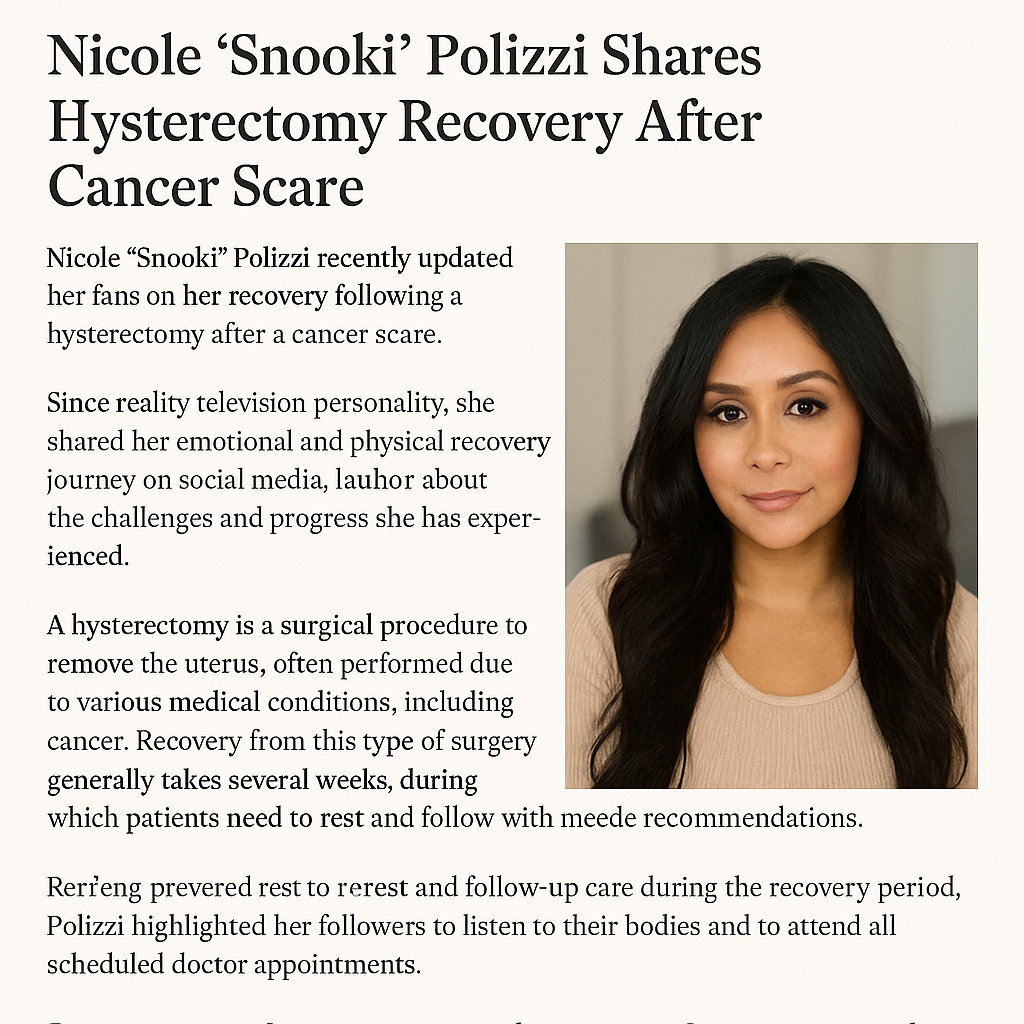
Nicole ‘Snooki’ Polizzi’s emotional recovery story matters because it sits at the messy intersection of celebrity health, women’s surgery, and public vulnerability. The former Jersey Shore star has spoken openly about a hysterectomy after a cancer scare, and that detail changes the tone of the story fast. This was not a publicity stunt. It was a blunt reminder that fame does not shield anyone from fear, pain, or hard medical choices.
Key Takeaways- Snooki’s story is about medical recovery, not tabloid spectacle.
- A cancer scare can force quick decisions and a lot of emotional strain.
- Public figures often share health updates in fragments, so context matters.
- Recovery from a hysterectomy is both physical and emotional, and the emotional part gets ignored too often.
- The real issue is human frailty, not celebrity branding.
What is Nicole ‘Snooki’ Polizzi’s hysterectomy recovery story?
It is a health update with real stakes. Nicole ‘Snooki’ Polizzi, best known from Jersey Shore, has described getting emotional while recovering from a hysterectomy after what she called a cancer scare. That is the plain version. No fancy wrapping needed.
A hysterectomy is major surgery. It can be recommended for many reasons, including fibroids, endometriosis, abnormal bleeding, or concern about cancer. In Snooki’s case, the public focus has been on the fear that preceded the surgery and the feelings that followed it. I’ve covered celebrity health stories long enough to know the same script appears again and again: people hear a headline, skim the dramatic part, and miss the medical reality underneath.
Here’s the kicker. A celebrity health story is never just about the person. It becomes about image, motherhood, work, marriage, aging, and body autonomy all at once. That is why these stories pull more attention than they probably should, and why they also deserve a little charity in judgment. A person is not a brand mascot. She is a human being with a body that can fail.
The emotional angle matters because surgery after a cancer scare is not a tidy PR beat. It can stir up fear, gratitude, anger, and exhaustion in the same afternoon. The public often wants a neat arc: scare, surgery, recovery, smile. Real life is usually less polished. Anyone pretending otherwise is selling something.
For readers wanting broader celebrity context, it helps to compare this with other high-profile health disclosures, such as coverage of famous people dealing with illness or injury in CNN coverage of public health stories, or the way entertainment outlets frame private medical updates in People magazine. Different outlets tell the same story with different levels of gloss.
And yes, that matters. Because the story is not simply that Snooki cried. It is that she confronted uncertainty, underwent a serious procedure, and then had to live through the emotional aftermath in public.
Core Details and Context
- Nicole ‘Snooki’ Polizzi rose to fame on Jersey Shore, where her public image was built on loud humor, chaos, and blunt honesty.
- The hysterectomy discussion brought a different side of her into view: a mother dealing with fear about her health.
- A cancer scare changes the meaning of a medical procedure. It is no longer just treatment. It becomes a reckoning.
- Recovery from hysterectomy can involve fatigue, pain management, hormone-related symptoms depending on the type of surgery, and a period of emotional readjustment.
Frankly, a lot of celebrity coverage gets this wrong. It either turns the person into a saint or a mess. Neither is useful. Snooki is neither. She is a public figure whose life has long been packaged for viewers who enjoy spectacle, but this moment is different because the stakes are not ratings. They are bodily integrity and peace of mind.
The main context here is that hysterectomy is not minor surgery. It affects the uterus, and sometimes other reproductive structures depending on the medical need. The emotional response can be intense, especially for women who associate the procedure with fertility, femininity, or a deeply personal chapter of life. Those associations are not trivial, and no amount of online sarcasm changes that.
I think the most revealing part of these updates is what people do not say. They do not always spell out the sleepless nights, the fear before pathology results, or the strange quiet that follows the surgery once the adrenaline fades. The public sees a quote or a social post. The body experiences the rest.
A subtle Catholic truth sits under all of this: human dignity does not rise and fall with health, fertility, or public approval. A person remains a person even when surgery strips away comfort and control. That is not sentimentality. It is reality.
For a wider look at how media treats famous women’s personal lives, compare this with stories in the entertainment press or with health coverage that tries to balance privacy and reporting, like TODAY’s celebrity and health reporting. The good outlets keep the focus on the facts instead of gawking.
Timeline and Step-by-Step
- Health concern surfaced. Snooki’s comments about a cancer scare brought the issue into view. That is where the public story began, though the private worry likely began earlier.
- Medical evaluation followed. This is the part everyone skips. Scares usually involve scans, exams, consultations, and a whole lot of waiting. I’ve seen enough of these stories to say that waiting is often the worst part.
- Hysterectomy was performed. The surgery itself was the practical response to the medical concern. That means the story moved from fear to action, which is sometimes the only honest thing a patient can do.
- Recovery began. Recovery after hysterectomy can involve pain, rest, follow-up visits, and a gradual return to normal routines. Normal, though, may look different afterward. That is not drama. That is physiology.
- Emotions surfaced publicly. Snooki getting emotional during recovery is not surprising. It is almost the expected part no one wants to admit. The body heals slowly, and the mind catches up even more slowly.
- Fans and media responded. This is where the story becomes collective. Some people offer support. Others make crude jokes. The split tells you more about the audience than about the celebrity.
If you want context on how public figures handle personal medical issues while still working in entertainment, NBC News often covers the balance between privacy and public interest better than gossip mills do. Not perfectly, mind you. Better.
The step-by-step pattern also shows why celebrity health stories become so sticky. They have a beginning that sounds dramatic, a middle that is medically serious, and an ending that is never fully neat. Real healing is slow. People hate that. The tabloids hate it more.

Comparison Table
| Factor | Snooki’s Hysterectomy Recovery Story | Generic Celebrity Health Stunt Narrative |
|---|
| Core issue | Real medical surgery after a cancer scare | Attention-seeking or vague announcement |
| Emotional weight | High, because health fear is personal | Often low or manufactured |
| Public reaction | Support, concern, empathy, debate | Skepticism, cynicism, click-driven chatter |
| Media value | Human story with medical context | Fast-turn gossip with little depth |
| Risk of distortion | Moderate, because private details are missing | High, because motive is often guessed |
| Long-term relevance | Strong, because recovery affects daily life | Weak, because the story usually fades fast |
| Ethical focus | Privacy, dignity, and bodily reality | Speculation, branding, and noise |
The real competition here is not another celebrity. It is the lazy habit of treating all public health news as content fodder. That habit is old, tired, and usually wrong.
When I compare these stories, the difference is simple. One reflects a person dealing with a real medical event. The other often exists to fill a news hole. Same headlines, wildly different moral weight.
For more on how entertainment and health reporting are handled by mainstream outlets, see USA TODAY’s entertainment coverage and ABC News. They do not always get it right, but they at least tend to separate rumor from confirmed detail better than the lowest-rent gossip blogs.
Common Misconceptions and What to Know
First misconception: If a celebrity shares a health update, you know the whole story.
No, you do not. You know the part they chose to say publicly, and that is all. Anything beyond that is guesswork unless confirmed by the person or her doctors. People love to act informed after reading one caption. That is not research. That is social media theater.
Second misconception: A hysterectomy is only a physical event.
Wrong again. It can affect identity, emotions, and a person’s sense of control. For some women, it also touches on fertility grief, even when the surgery is medically necessary and clearly the right call. The mind does not always keep up with the charts and scans.
Third misconception: Emotional reactions mean weakness.
That is nonsense. Crying after a cancer scare and major surgery is not weakness. It is evidence that the person understands the stakes. Frankly, cold detachment is not a virtue here. Human beings are not machines, and pretending otherwise is a bad habit dressed up as strength.
Fourth misconception: Celebrity health stories are mostly performance.
Sometimes they are curated, yes. Sometimes they are edited for PR. But not everything is fake just because it is public. That’s the cheap cynic’s shortcut. Real pain exists even when cameras are nearby.
I’ll say it plainly: the morally safer posture is charity. Not naivety. Charity. That means assuming the person in front of you is more than a clip, a meme, or a headline. The old wisdom still holds—judge carefully, because surface appearances miss a great deal.
For readers interested in the broader pattern of public-facing health disclosures, the CDC offers straightforward information on women’s health topics, and while that is not celebrity gossip, it helps ground the conversation in reality instead of rumor.
Frequently Asked Questions
What happened to Nicole ‘Snooki’ Polizzi?
She reportedly underwent a hysterectomy after a cancer scare and became emotional during recovery. The public details are limited, which is normal for a private medical event.
Why would someone have a hysterectomy after a cancer scare?
Doctors may recommend surgery if tests, symptoms, or imaging raise serious concern. The exact reason depends on the individual case, and not every scare means cancer is confirmed.
Is hysterectomy recovery difficult?
It can be. Recovery often includes pain, fatigue, activity limits, and emotional strain. Some people recover smoothly; others need more time. Bodies do not follow a press schedule.
Why did Snooki’s story get so much attention?
Because she is a well-known public figure, and health stories involving celebrities spread quickly. Add a cancer scare and an emotional recovery, and the media machine does what it always does: it amplifies.
Final Thought
This story is not really about fame.
It is about the strange moment when a famous person becomes, for all practical purposes, just a frightened human being trying to heal, and that should make anyone pause before they crack a joke or force a hot take. The body is not a costume. It is the place where joy, fear, motherhood, pain, and endurance all show up whether we like it or not.
That is why Snooki’s hysterectomy recovery resonates beyond the usual celebrity churn. It reminds people that public figures are not cartoons, even when the media treats them that way. They have organs, nerves, histories, and private worries that do not disappear under studio lights. The decent response is not worship and not ridicule. It is a little humility.
And honestly, that is rare enough to matter.