MSC Seascape FBI Investigation: What We Know About the Cruise Ship Death
The FBI is investigating a suspected homicide aboard MSC Seascape after the cruise ship returned to Galveston, Texas, on the morning after leaving port. The passenger who died has not been identified publicly, officials have not explained how the death occurred, and no arrest has been confirmed by authorities.
The central fact is stark; the details remain thin. According to reporting by The U.S. Sun, the FBI confirmed its investigation and said it was working with the U.S. Coast Guard, Port of Galveston Police Department and U.S. Customs and Border Protection. MSC Cruises said the authorities directed the ship to return after a guest incident, and that it was cooperating. That is the public record so far—not a verdict, not a named suspect, and not an explanation of what happened.
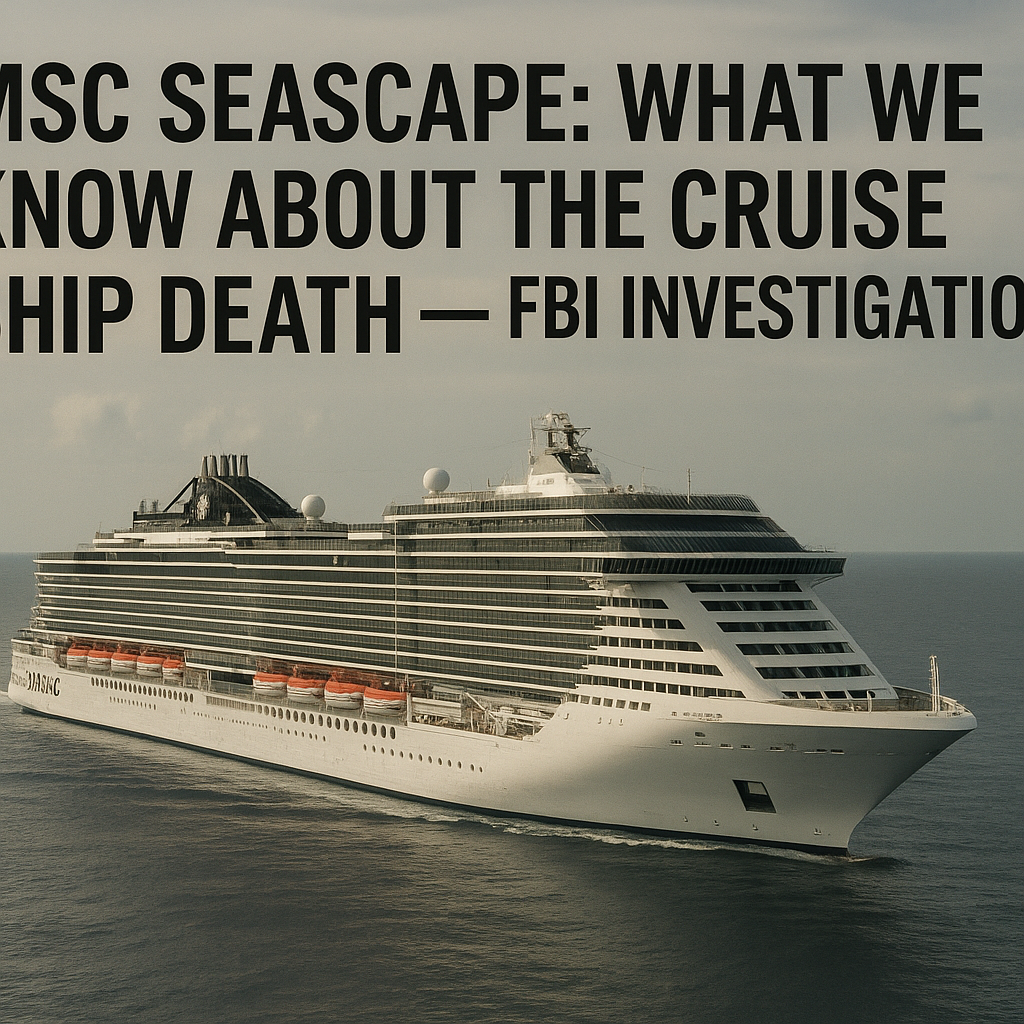
What Is the MSC Seascape Suspected Homicide Investigation?
The phrase “suspected homicide investigation” describes a criminal inquiry into a death that authorities believe may have resulted from another person’s actions. It does not, by itself, establish how the person died, who may be responsible, or whether anyone will face charges. In this case, the FBI’s Houston office confirmed that it was investigating a suspected homicide aboard MSC Seascape, according to the news report. The agency has not publicly announced the deceased passenger’s name or provided a detailed account of the incident.
That distinction matters. Headlines can turn a preliminary investigation into a ready-made crime story, complete with a villain and a supposed motive. But neither is supported by the known information. A homicide investigation is a process for gathering and assessing evidence; it is not a public declaration that a particular passenger committed a crime. I’ve tracked enough breaking stories to know that an empty space in the timeline tends to attract confident guesses. Those guesses are not evidence.
The ship was on a planned seven-day Caribbean sailing after departing Galveston on Sunday, November 8. It returned to port on Monday morning following what MSC called a guest incident, then left again and resumed its planned itinerary. MSC’s statement, as reported by The U.S. Sun, said the company was cooperating with authorities and supporting people affected. The statement did not describe the death or identify anyone involved.
The FBI’s participation tells readers that federal investigators are involved; it does not explain, on its own, the precise legal basis for the investigation or which authority might make a charging decision. Investigations aboard ships can involve several agencies, and their roles depend on facts that have not been made public here. The FBI’s Houston field-office page is useful institutional context, but it is not a case update. That difference is worth keeping clear.
The passenger’s dignity should not get lost in the rush for a shocking detail. A person is more than the circumstances of their death, and the public has not yet been given the basic information needed to understand who they were. For now, careful reporting means sticking to what officials and the cruise line have actually said, and leaving speculation where it belongs: outside the facts.
Core Details and Context
Several details have been reported, but they do not all carry the same weight. The FBI’s confirmation of a suspected homicide and MSC’s account of being directed to return are statements attributed to the organizations involved. A witness account reported by KGTX 7 is a different kind of information: it may be relevant, but officials have not confirmed that it represents an arrest or that the person described was connected to the death.
Here is what the public can reasonably take from the current reporting:
- A death occurred aboard MSC Seascape. The report says authorities are investigating it as a suspected homicide. No public account establishes the precise time or cause of death.
- The vessel returned to Galveston. MSC said authorities instructed the ship to come back after a guest incident. The ship later departed again.
- Several agencies are involved. The FBI’s Houston office said it was working with the U.S. Coast Guard, Port of Galveston Police Department and Customs and Border Protection.
- The deceased passenger has not been identified. No name or other identifying information had been released in the reporting described here.
- No arrest has been officially announced. That remains true even though a witness account described a man being escorted off in handcuffs.
- The cruise itinerary was expected to continue. The listed stops were Costa Maya and Cozumel in Mexico and Roatán in Honduras, with a planned return to Texas on November 15.
Frankly, a ship’s quick return to port is not proof of any one explanation. It shows that authorities directed a change in the vessel’s movements after an incident; it does not tell the public what investigators found aboard, what interviews took place, or whether the ship had already secured relevant evidence. MSC said it was cooperating, but the company has not publicly supplied those details in the reported statement.
The same restraint applies to the reported handcuffs. KGTX 7 said a confirmed passenger witnessed a man being escorted off the ship, followed by an ambulance leaving the area. That account is notable, but it does not establish the man’s identity, why he was escorted off, whether he was detained, or whether he was suspected in the death. No official confirmation has connected him to the investigation. Treating a visual observation as proof of guilt would be a serious mistake.
MSC Seascape’s size helps explain the public interest, but it does not change the standard of proof. The vessel is described as roughly 1,112 feet long, with 20 decks, 15 accessible to passengers, and among the largest ships in MSC Cruises’ fleet. The company’s official MSC Seascape profile offers ship information, not evidence about this incident. A large vessel can make a dramatic setting; it cannot fill gaps in the record.
There is also a separate past event that should not be folded into this case. The report notes that MSC Seascape was at the center of a search operation in November 2023 after a 30-year-old crew member went overboard near Puerto Rico. That earlier search is not evidence about the present death, and no connection between the two events has been reported. Similar locations, ships, or dates can create an illusion of a pattern where none has been established.
Timeline: What Happened, and When?
The available timeline is brief. It describes a planned cruise, a return to port, and the start of a multi-agency investigation, while leaving the most important minutes and hours unexplained. No public account has yet stated exactly when the passenger died or when someone first alerted the crew.
- Sunday, November 8: MSC Seascape departs Galveston. The ship begins a planned seven-day Caribbean voyage. The intended itinerary includes Costa Maya and Cozumel in Mexico and Roatán in Honduras. The report does not provide a precise departure time or details of the passenger’s movements after embarkation.
- An incident involving a passenger is reported. MSC later describes a “guest incident” and says authorities instructed the vessel to return. That wording does not explain the event. Officials have not publicly said when the death occurred, when it was discovered, or what the crew first knew.
- Monday morning: the ship returns to Galveston. Federal investigators board as authorities begin examining the circumstances surrounding the death, according to local reporting. The public account does not identify which evidence was collected or describe interviews, searches, or other investigative steps.
- Agencies confirm their involvement. The FBI’s Houston office says it is investigating a suspected homicide and working with the Coast Guard, Port of Galveston Police Department and Customs and Border Protection. The involvement of several agencies is confirmed; their individual tasks in this case have not been detailed publicly.
- A witness account adds an unconfirmed detail. KGTX 7 reports that a passenger saw a man escorted off in handcuffs and then an ambulance leaving the area. Authorities have not confirmed an arrest or said the man was connected to the death. The order and meaning of those observations remain uncertain.
- MSC Seascape leaves port and resumes sailing. MSC says the ship returned as directed, cooperated with investigators and then resumed its planned itinerary. The listed schedule includes a return to Texas on November 15. The ship’s departure is not an announcement that the investigation has ended or that authorities have cleared anyone.
When I sort a developing story, I separate the order of events from the explanation for them. The first is partly visible here: the vessel sailed, returned, and sailed again. The second—the cause of death, the events surrounding it, and any person’s role—has not been made public. That difference can feel unsatisfying, but it is the honest limit of the timeline.
A timeline may also change as authorities verify dates and accounts. Early reporting can contain estimates, partial observations, or details that later require correction. That is normal in a live investigation, not a reason to fill gaps with a theory. Readers should watch for direct updates from the FBI, local authorities, the Coast Guard, Customs and Border Protection, or MSC rather than treating recycled summaries as new information.
Comparison: Confirmed Information vs. Unverified Account
There is no meaningful rival cruise ship or competing company to compare in this story. The useful comparison is between what authorities and MSC have confirmed, and what a witness account has reported but officials have not verified. Mixing those categories is one of the easiest ways for an early crime report to become misleading.
| Detail | Officially reported or confirmed | Reported witness account | What remains unknown |
|---|
| Death aboard the ship | Authorities are investigating a suspected homicide | Not applicable | Identity, cause and time of death |
| Return to Galveston | MSC said authorities instructed the ship to return after a guest incident | Not applicable | What prompted the instruction in detail |
| Agencies involved | FBI Houston named the Coast Guard, Port of Galveston Police and CBP as partners | Not applicable | Each agency’s specific role |
| Man escorted from ship | No arrest has been announced by authorities | KGTX 7 described a passenger seeing a man taken off in handcuffs | Identity, reason for escort and any connection to the death |
| Ship’s itinerary | MSC said the vessel left port and resumed its planned voyage | Not applicable | Whether later schedule changes occurred |
The comparison is simple, but important. A confirmed investigation is not the same thing as a confirmed arrest. The handcuffs detail may prove accurate as an observation, yet its interpretation remains unsettled. A person can be escorted from a vessel for many reasons, and the witness report alone cannot establish the reason in this case.
Likewise, a statement that a ship resumed its itinerary does not establish that investigators had finished every task. MSC said the ship left port; no public statement described that departure as a formal clearance. Operational decisions and criminal investigations are different processes. One concerns a vessel’s voyage, while the other concerns evidence, accounts, and legal questions that may take longer to resolve.
For further background, the U.S. Coast Guard’s official website and CBP’s official site explain the agencies’ general public-facing work. Those pages do not confirm the details of this particular investigation. That caveat matters: an agency’s presence in a story should not be mistaken for a published finding by that agency.
The safest reading is also the least theatrical: the FBI says it is investigating a suspected homicide; the cruise line says it complied with the instruction to return and is cooperating; a local report describes an unconfirmed observation; and the core facts remain undisclosed. It is not a satisfying ending. It is, however, a fair account of what is known.
Common Misconceptions and What to Know
Misconception: A homicide investigation means investigators have proved a murder occurred. Not necessarily. The phrase signals the nature of the inquiry as reported by the FBI, but the public has not been given a cause of death or a final finding. Investigators gather evidence and test accounts; conclusions may change as that work proceeds. The word “suspected” is not decorative. It tells readers that the matter is under investigation, not resolved.
Misconception: The man seen in handcuffs must be the suspect. No official has said that. KGTX 7 reported a witness’s observation, but authorities have not confirmed an arrest or linked the man to the death. The difference between seeing someone escorted off and knowing why is enormous. The truth is, the handcuffs have become the most vivid detail precisely because the official record is otherwise sparse. Vivid is not the same as verified.
Misconception: The ship returning to Galveston proves a crime happened at sea in a specific way. The return is reported, and MSC said authorities directed it. Public information does not establish exactly where or when the death happened, or what led officials to request the return. The ship’s position is not a substitute for a factual account of events. Nor does a return automatically reveal the jurisdictional or legal reasoning behind the decision.
Misconception: The ship resuming its voyage means the case is closed. MSC said the vessel left port and continued its planned itinerary. That statement describes the ship’s movements; it does not announce the end of the FBI investigation. There is no reported official finding that clears a person, and no report that the agencies have concluded their work. A vessel can sail while investigators continue to examine a case.
Misconception: The 2023 overboard search is part of this investigation. The earlier incident involved a crew member who went overboard near Puerto Rico, according to the report. No connection to the current suspected homicide has been reported. The presence of a previous event in the same ship’s history may be relevant background, but it cannot be used to imply a link without evidence. Repetition of a ship name is not proof of a shared cause.
Misconception: A lack of public detail means authorities have no information. It means the information has not been released in the reporting available. Investigators may withhold details for reasons that are not public, but that general possibility should not be presented as a confirmed explanation for the silence here. We simply do not know why each detail has not been disclosed. It is fair to ask questions; it is not fair to answer them with invention.
Most celebrity and crime coverage rewards certainty, even when certainty is premature. Here, the responsible approach is less exciting and more useful: preserve the distinction between a death, a suspected homicide inquiry, an eyewitness account and a confirmed arrest. There are real people at the center of this story, including a person who died and passengers who may have experienced a frightening disruption. Charity in judgment is not softness toward wrongdoing; it is a refusal to condemn someone before facts support it.
Frequently Asked Questions
What happened aboard MSC Seascape?
The cruise ship returned to Galveston after departing on a planned Caribbean voyage. The FBI’s Houston office confirmed it was investigating a suspected homicide aboard the vessel, according to reporting by The U.S. Sun. The passenger who died has not been identified publicly, and officials have not released the circumstances or timing of the death. MSC said authorities instructed the ship to return after a guest incident. It later left port and resumed its itinerary.
Has anyone been arrested in connection with the death?
No arrest has been announced by authorities in the reporting described here. KGTX 7 reported that a passenger saw a man escorted off the ship in handcuffs, followed by an ambulance leaving the area. Officials have not confirmed that an arrest took place, identified the man, or said that he was connected to the suspected homicide. The witness account should not be treated as an official finding.
Who is investigating the case?
The FBI’s Houston office said it was investigating and working with the U.S. Coast Guard, Port of Galveston Police Department and U.S. Customs and Border Protection. The public account does not detail each agency’s role or disclose what investigative steps have been completed. The presence of multiple agencies does not, by itself, establish what happened or who might be responsible.
Did MSC Seascape continue its cruise?
Yes. MSC said the ship left Galveston after returning as directed and resumed its planned itinerary. The listed voyage included stops in Costa Maya and Cozumel in Mexico and Roatán in Honduras, with a planned return to Texas on November 15. That itinerary update is not a statement that the investigation has concluded. No official case resolution has been reported.
The next meaningful update will be one that adds verified facts: an official identification, a clearer account of the death, a confirmed arrest or a statement about the investigation’s status. Until then, the absence of detail should be treated as a limit, not an invitation to guess. The passengers, crew and family of the deceased deserve accurate reporting more than a fast theory.
A cruise ship can be a floating city, but that does not make the people aboard characters in a thriller. The person who died deserves dignity; anyone who may be questioned or investigated deserves the presumption that facts—not rumor—will decide what follows. I will trust the carefully attributed detail over the dramatic version every time. For now, the FBI inquiry is real, the witness account remains unconfirmed, and the most important answers are still outstanding.