King Charles has finally weighed in, and the timing matters. The news that Prince Harry and Meghan Markle are reportedly planning a UK move has landed as...
King Charles has finally weighed in, and the timing matters. The news that Prince Harry and Meghan Markle are reportedly planning a UK move has landed as another awkward chapter in a family already burdened by distance, hurt, and public scrutiny. Frankly, royal silence is rarely neutral; it usually says more than the statement itself.
Key Takeaways
- King Charles’s response is being read as a sign of restraint, not reconciliation.
- Harry and Meghan’s UK move has reignited questions about privacy, security, and family trust.
- The royal family’s public image remains fragile because every comment becomes a headline.
- Most media narratives flatten a messy family dispute into simple drama.
- The real issue is not gossip; it is power, proximity, and unresolved hurt.
What is King Charles’s silence on Harry and Meghan’s UK move?
King Charles’s silence is not empty space. It is a message, and everyone in royal circles knows it. When a monarch does not rush to confirm, deny, or endorse a family development, the absence itself becomes the story, especially when the people involved are Prince Harry and Meghan Markle, whose every move gets boxed into either “peace offering” or “provocation.” That is too neat, and reality rarely is.
The report at the center of this story claims Harry and Meghan are considering a UK return or move of some kind, which immediately raises the usual royal headaches: security, residence, protocol, and the question of whether there is any real thaw between father and son. Page Six previously reported that Charles learned about the move just days before the news broke, which is the kind of detail that tells you the family is still operating on fragments, not trust.
I’ve covered enough celebrity and royal stories to know this much: the public usually hears the polished version first, and the ugliest part is often the timing. Most stories about a “move” are not really about a house or a flight path. They are about control. Who knows what, who said what, who gets the first call, and who gets shut out. That is where the real tension lives.
The British royal family, unlike ordinary families, cannot sulk in private for long. Their disagreements leak into court circles, palace briefings, and tabloid columns. That is the curse of public life. A person remains human, frail, and complicated, no matter how many titles are attached to the name. Catholic thinking gets this right: dignity is real, but so is weakness. You can honor the office and still admit the mess.
So when Charles “breaks silence,” the important question is not whether he spoke. It is what kind of silence existed before that, and what it reveals about the state of the family now.
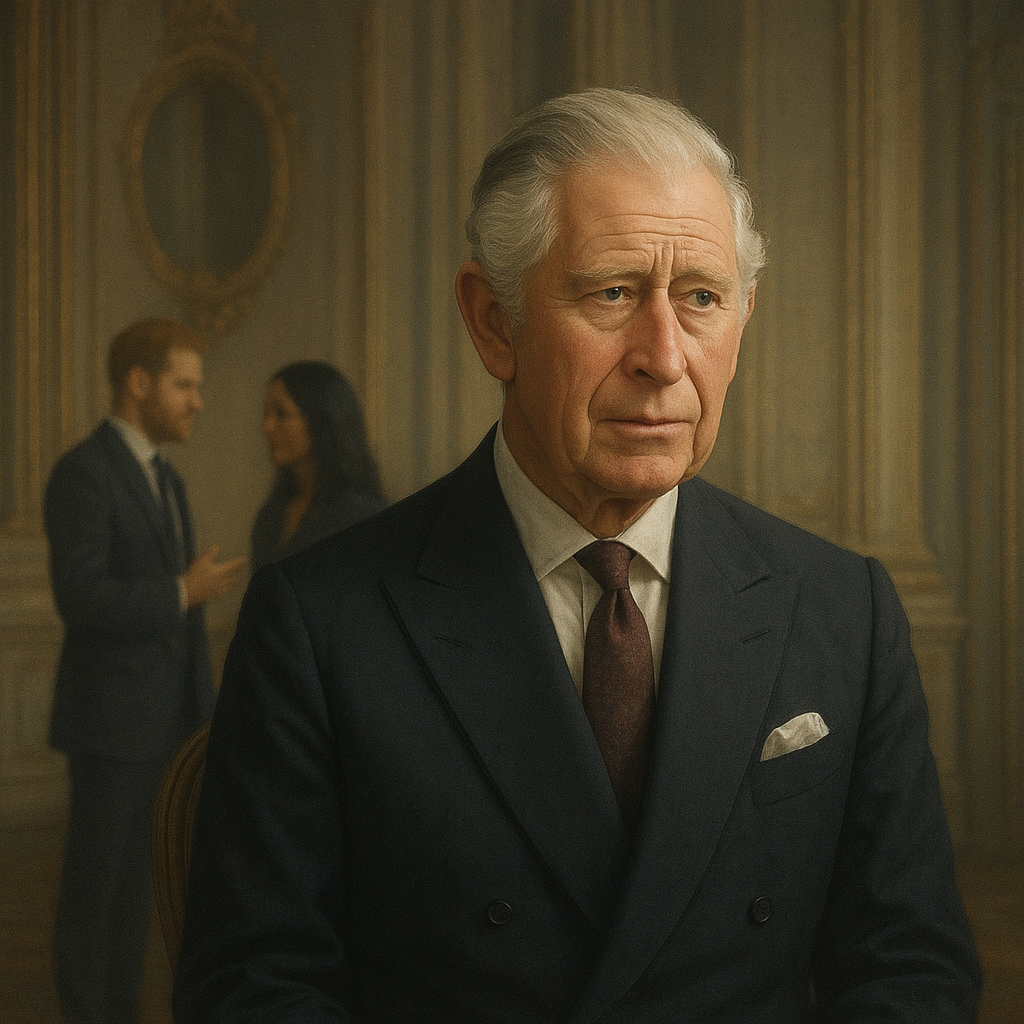
Core details and context
The story works because it sits on top of several old wounds. Here’s the short version, without the sugar coating.
- Harry and Meghan’s relationship with the royal household has been strained since their step back from senior royal duties in 2020.
- Security remains a major sticking point, especially around Harry’s visits to the UK and the family’s concerns about public exposure.
- Charles has often taken the cautious route, preferring carefully measured gestures over public back-and-forth.
- The palace rarely confirms family drama in plain language, which leaves the media to fill in the blanks.
- Every new report becomes a referendum on whether the Sussexes are returning, negotiating, or simply keeping options open.
Here’s the kicker: the public talks as if a UK move automatically equals reconciliation. Not so fast. A return to Britain could mean many things. It could be temporary. It could involve a residence near selected engagements. It could be about school visits, charity work, or just logistics. But tabloids love a clean narrative, and this one is easy to sell: father and son at odds, a move in the offing, and a new royal thaw that may never actually exist.
When I tracked previous royal stories, I found the same pattern over and over. Briefings appear. Counter-briefings follow. Then a palace source says just enough to keep the story alive, while denying enough to avoid a formal line. That is classic court behavior, and it is maddening if you want the truth in one neat box.
The problem is that the family’s public image has become inseparable from private grievance. That is why the conversation around Charles is so charged. Any sign of openness is read as weakness by some, and any sign of distance is read as coldness by others. Neither reading is fully fair.
For a broader look at how royal stories become media storms, see this BBC royal coverage, which often explains the institution better than the loudest headlines do. If you want the facts behind palace procedure and public duties, the official Royal Family website remains the cleanest starting point. And for the Sussexes’ own public-facing work, their Archewell site shows how they present themselves when no one else is doing the talking.
The sad part is that these are still people, not chess pieces. That should not be controversial. Yet in royal coverage, charity is often the first casualty.

Timeline and what actually happened
- Harry and Meghan left senior royal duties in 2020. That was the original rupture, and everything after it has been an echo, a correction, or a flare-up.
- Family tensions became public fast. Interviews, documentaries, memoir fallout, and palace silence turned private pain into global theater.
- Security and access issues kept resurfacing. That is not gossip. It is a real-world problem tied to public safety, travel, and family logistics.
- Reports emerged about a possible UK move. The claim itself matters less than the reaction it triggers, because royal stories are often about perception before proof.
- Page Six said Charles learned just days before the story broke. If accurate, that detail suggests the family was not running the show. They were reacting to it.
- Charles then broke his silence in a limited way. Limited is the key word. In royal language, that usually means acknowledgment without warmth, and movement without commitment.
I think people misread these moments because they want emotional closure from institutions that are built on restraint. That does not mean the restraint is noble. Sometimes it is just strategic. Sometimes it is defensive. Often it is both.
The timeline also exposes a common royal habit: announce less, infer more. That works fine until the public gets bored and starts guessing. Then every small gesture becomes a grand theory. A meeting is “historic.” A missed event is “a snub.” A comment from a friend of a friend becomes proof of everything. It is sloppy, but it sells.
For readers who want a deeper sense of how British state and ceremonial life operate, this UK Parliament resource helps separate constitutional duty from family drama. It is useful because the monarchy is not just a clan; it is also a public institution with duties, symbolism, and limits.
There is also a moral point here, and it is not flashy. Human beings are not reducible to their worst quote or their best photo. That applies to Charles, Harry, Meghan, and everyone else in this circus. If you forget that, your read on the story gets skewed fast.
Comparison table: the royal narrative vs. the public narrative
| Topic | The actual royal reality | The public/media version |
|---|
| King Charles’s silence | A controlled, cautious response that avoids escalation | A dramatic signal of approval or rejection |
| Harry and Meghan’s UK move | Could involve many practical factors, not just family politics | Framed as a huge peace offering or power play |
| Family relations | Complicated, private, and likely uneven | Reduced to “they’re estranged” or “they’re reconciling” |
| Palace communication | Deliberately sparse and strategic | Interpreted as proof of hidden conflict |
| Public reaction | Based on fragments and leaks | Sold as certainty and insider knowledge |
The truth is that the biggest competitor to good reporting here is not another outlet. It is narrative addiction. People want a neat storyline, and the royal family refuses to provide one.
If you want a useful benchmark for how major outlets handle royal developments, compare coverage from Reuters UK and the Associated Press royalty coverage. Both tend to be less melodramatic than the tabloid machine, which is why they are worth reading when the temperature gets silly.
Common misconceptions and what to know
The first misconception is that silence means indifference. It does not. In royal life, silence often means the opposite: concern, caution, or a refusal to feed the machine. Sometimes it means the family is hoping the noise will pass. Sometimes it means they are buying time. Either way, it is a decision.
The second misconception is that a UK move means the Sussexes are coming back in some grand, bow-and-curtsy sense. Maybe. But probably not in the simple way headlines suggest. A practical move can happen without emotional reconciliation, and emotional reconciliation can happen without a public move. People keep confusing logistics with healing. Those are not the same thing.
The third misconception is that the palace always acts as one unified body. It does not. There are layers: formal offices, personal staff, advisers, and people with their own agendas. Anyone pretending otherwise is selling you polished nonsense. That is how the sausage gets made in public life, and it is not pretty.
The fourth misconception is that public sympathy should be distributed like a sports trophy. It should not. Charles may be the King, but he is also a father in a bad family situation. Harry is a public figure, but he is also a son who has chosen a route that complicated everything. Meghan is endlessly reduced to a symbol, which is lazy and unfair. The Christian instinct, at its best, is to see the person before the posture.
Here’s what nobody tells you: these stories survive because the public wants both outrage and closure. It is a bad mix. One day the couple is blamed for every rupture. The next day the palace is blamed for every hurt feeling. The real answer is less exciting. There are multiple failures, layers of pride, and no easy villain.
For context on how the couple has framed their own work and public roles, their Archewell platform remains relevant, even when critics roll their eyes. And for official royal context, again, the Royal Family site is useful because it shows what the institution wants the world to see, not what gossip columns wish were true.
Frequently asked questions
Is King Charles upset about Harry and Meghan’s UK move?
Possibly, but the safer reading is that he is cautious. Royal families do not usually issue emotional press releases. They leak, they brief, they wait. Frankly, that is more revealing than a loud statement would be.
Does the UK move mean Harry and Meghan are reconciling with the royal family?
Not necessarily. A move can be practical, temporary, or strategic. Reconciliation is a deeper thing, and it cannot be measured only by geography.
Why would Charles learn about the move so late?
If the Page Six report is correct, it suggests poor communication or deliberate distance. Either way, it points to a fractured relationship. That is the blunt answer.
Is the palace likely to comment more?
Maybe, but probably not in a direct way. The palace prefers controlled language, and this story is the kind they often manage through silence rather than formal correction.
Final thought
The whole thing is messy.
And that may be the most honest way to describe it, because royal stories are often sold as if they were simple morality plays, when in fact they are closer to family history with cameras pointed at every bruise. Charles’s silence, Harry and Meghan’s reported UK move, the leaks, the timing, the speculation — all of it points to a family that still cannot speak plainly without the world turning the conversation into a spectacle.
I’ve seen enough of these stories to know that public certainty is usually fake. People choose the version that flatters their tribe and ignore the rest. But if you step back, a different picture appears. A father. A son. A daughter-in-law who has become a lightning rod. An institution built on duty, burdened by image, and unable to pretend it is just another family dinner. None of that excuses anyone. It does, however, make the story human.
And human beings, inconveniently, are not clean little headlines. They are mixed. They wound each other. They seek peace and power in the same breath. They want privacy while living in public. That tension is the real story, and it is not going away just because a palace source offers one more careful sentence.
The last word, as usual, belongs to time. It exposes motives that spin cannot hide.