Kentucky Officer Andy Winans Attends Wife Lauren Winans’ Hearing in Child Abuse Case
The reported Kentucky case centers on serious criminal charges against Lauren Winans, who has pleaded not guilty, and the court testimony supporting those allegations. Her husband, Bardstown police officer Andy Winans, attended a bond hearing in Nelson County; attendance is not evidence of guilt, innocence, or involvement.
Key Takeaways
- Lauren Winans is charged with first-degree sodomy, incest, and sexual abuse involving a child under 12; she has pleaded not guilty.
- A detective testified that an 11-year-old boy reported alleged abuse after an argument with Winans over the phone.
- The detective described three alleged incidents in 2022 and said the investigation led to Winans’s arrest in October 2026.
- Andy Winans attended the hearing. No claim of wrongdoing by him is reported.
- Charges and testimony are not a conviction. The court process must determine what has been proved.
The allegations are grave, and the person at the center of them is a child whose privacy deserves protection. The account of the hearing says the alleged incidents occurred at Lauren Winans’s parents’ home in 2022, and that she was being held on $250,000 bond when the hearing was reported. The available details do not establish the ultimate outcome of the hearing, the full case record, or any later court ruling. Those limits matter. In legal reporting, a vivid allegation can quickly harden into a public verdict, even when a case is still at the accusation stage. Frankly, that is when careful wording matters most.
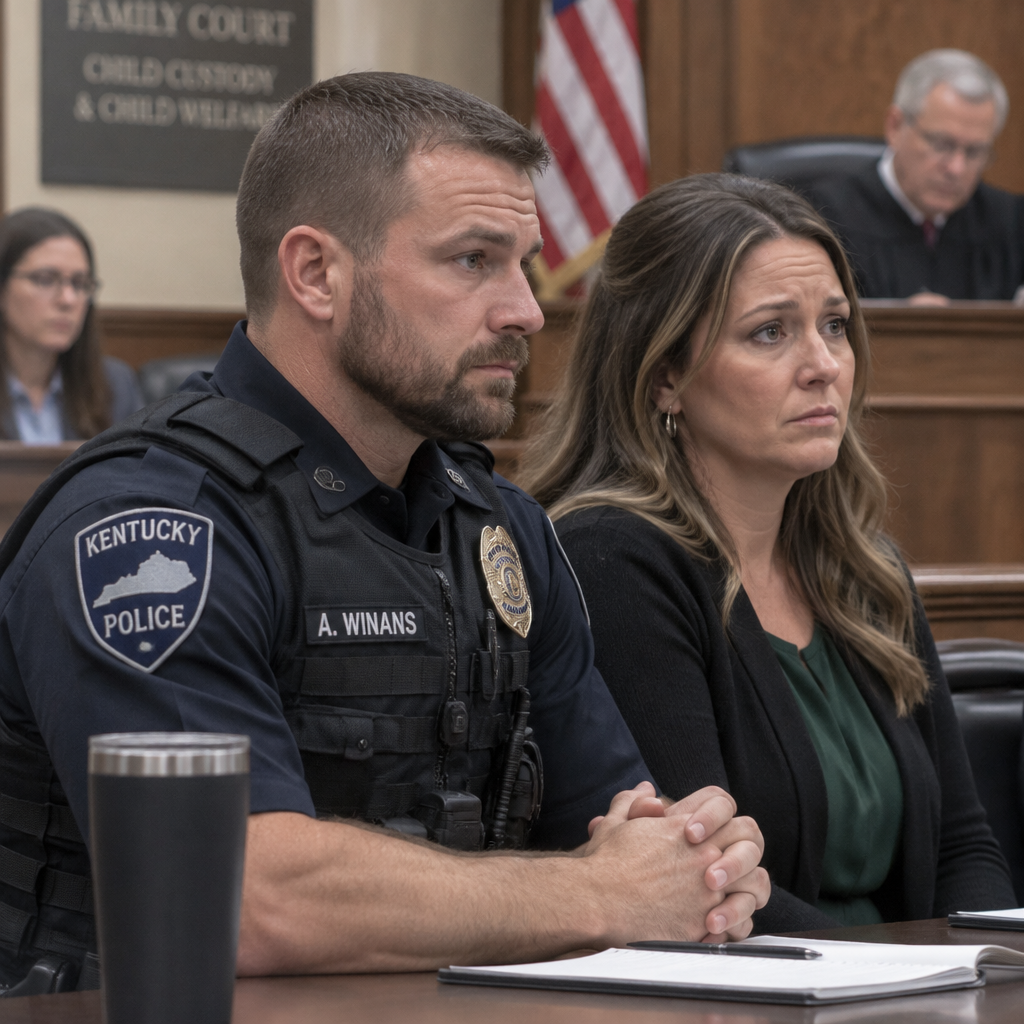
The court account also drew attention to Andy Winans’s presence in the gallery behind his wife. He is identified as a Bardstown Police Department officer, but the reported facts do not describe any charge against him or allege that he took part in the conduct under investigation. A spouse’s presence at a hearing can be emotionally striking; it is not a substitute for evidence about the case. The central questions remain what prosecutors allege, what the detective testified to, and what a court eventually finds. Here is what the reported record says—and what it does not say.
What Is the Lauren Winans Case?
This is a criminal case involving charges against Lauren Winans, not a finding that she committed the alleged acts. The charges reported are first-degree sodomy, incest, and sexual abuse involving a child under age 12. Winans has pleaded not guilty. That plea places the allegations in dispute; it is not a ruling on the evidence and should not be described as one.
At the bond hearing, a detective testified about how the allegation came to authorities and what the investigation uncovered, according to the account of the proceedings. The detective said an 11-year-old boy reported the matter to his stepmother after an argument with Winans over the phone. The stepmother then told the boy’s father, who contacted Kentucky State Police. The detective described three alleged incidents, said to have occurred in 2022 at Winans’s parents’ home.
The detective’s testimony, as reported, included an account that the boy told Winans to stop during one alleged incident because he felt uncomfortable, and that she characterized the conduct as "normal" before continuing. That is a serious claim, but it remains testimony about an allegation—not a verdict. A hearing can put evidence and arguments before a judge without resolving whether the charges have been proved beyond a reasonable doubt.
The charge names are legal categories, not a complete description of what a prosecutor must prove. The specific statutory language and the filed charging documents control; a news account may not include every element, amendment, or procedural detail. Readers looking for the text of Kentucky law should consult the Kentucky General Assembly’s statute portal, rather than infer legal definitions from headlines. The Kentucky Court of Justice criminal-case information also offers general context about criminal proceedings.
I separate three things when I read a case like this: the charge, the witness testimony, and the court’s eventual findings. They are related, but they are not interchangeable. Let’s be real: the first two can sound conclusive when repeated in a headline, while the third may not yet exist. The distinction protects the accused from being declared guilty before trial and protects the public’s understanding of what the court has actually decided.
The child’s name and identifying details should remain out of coverage. The reported account does not name him, and there is no public-interest reason to turn a child’s identity into a search term. The relevant information is the alleged sequence and the procedural status—not details that could expose or stigmatize him. A person is more than a public image or a legal label; that principle applies to a defendant, too, without weakening the seriousness of a child’s safety.
Core Details and Context
Several points in the reported hearing deserve close attention, and each has a different evidentiary status. The detective testified about the report, the investigation, and the alleged events. The charges are allegations filed against Winans. The not-guilty plea is her formal response. Andy Winans’s attendance is a separate fact about the hearing. Blending these categories creates a misleading story, even if the resulting version sounds cleaner or more dramatic.
- The initial report: The detective testified that the boy told his stepmother about the alleged abuse after an argument with Lauren Winans over the phone. The account says the stepmother was shocked and then told the boy’s father.
- Contact with authorities: The father reportedly contacted state police. A detective said he opened an investigation and later testified about what that investigation uncovered.
- The alleged conduct: The detective described three incidents in 2022. In his account, two involved alleged groping and one involved what he called "oral abuse." This article avoids graphic elaboration because the child’s privacy and the public’s need to understand the charge do not require it.
- The alleged response to a request to stop: The detective testified that, during the third alleged incident, the boy said he was uncomfortable and told Winans to stop. The detective said she called the conduct "normal" and continued. These statements are attributed to testimony; they have not been presented here as findings by a judge or jury.
- The arrest and bond: The account says Winans was arrested in October 2026 and was being held on $250,000 bond at the time described. It reports that she was brought to a bond hearing in shackles. The precise ruling made at that hearing, and any later bond changes, are not stated in the account.
- The husband’s attendance: Andy Winans sat in the gallery behind his wife and was present with other relatives. The account says Lauren turned and greeted him and the family members. It does not report that he addressed the court, discussed the case publicly, or faced charges.
The facts about the child’s account and the detective’s investigation are important, but testimony at a bond hearing is not the same thing as a trial record or a final judgment. The hearing’s purpose and the judge’s decision should not be guessed at where the details are not reported. That is the kicker: a dramatic courtroom image can travel farther than the careful explanation of what stage the case has reached.
The broader issue is child protection. Reports of sexual abuse require adults and authorities to take a child’s disclosure seriously, preserve privacy, and follow proper reporting and investigative procedures. The Centers for Disease Control and Prevention’s overview of child sexual abuse provides general information about the subject, while the U.S. Department of Justice’s child sexual abuse resources explain related federal law and enforcement. Neither source establishes what happened in this Kentucky case; that is for the case evidence and court process.
And the presence of a police officer spouse is not, on its own, a story about police misconduct. The reported account identifies Andy Winans as a Bardstown officer and says he attended the hearing. It does not report that the department issued a statement, that he was placed on leave, or that an investigation into him began. Those things should not be implied. Where an agency’s response or an employee’s status is not reported, the responsible description is simply that it is not reported.
Timeline: What the Reported Account Says Happened
- 2022 — The alleged incidents. The detective testified that all three alleged incidents occurred at Lauren Winans’s parents’ home in 2022. The account does not provide exact dates, and none should be invented. It describes two alleged instances of groping and a third incident involving alleged oral abuse.
- The boy tells his stepmother. According to the detective’s testimony, the allegation came to light after the boy argued with Winans over the phone and then told his stepmother what had allegedly happened. The report says the stepmother was shocked. It does not offer a verbatim statement from her or describe every conversation that followed.
- The father contacts state police. The detective testified that the stepmother told the boy’s father, who then called state police. That sequence matters because it shows how the allegation reached investigators, but it does not by itself resolve the truth of the accusation. Investigators must assess the information and evidence through proper procedures.
- An investigation follows. A detective testified that he investigated and identified three alleged incidents. He also described what the boy reportedly said about feeling uncomfortable and asking Winans to stop during one incident. The account does not give a full evidence inventory, forensic findings, interview records, or the contents of the charging documents.
- October 2026 — Winans is arrested. The report says Lauren Winans was arrested in October 2026 after what it described as a thorough investigation. It does not provide a full public chronology of investigative steps, so the adjective "thorough" should be understood as the account’s description, not an independently measured conclusion.
- The bond hearing. Winans appeared in Nelson County Circuit Court in shackles, according to the account, while her husband sat behind her in the gallery. The detective testified about the allegations. Winans had pleaded not guilty and was being held on $250,000 bond in the county jail, as reported. The account does not establish the exact order made at the hearing or later changes to custody status.

When I lay out the timeline, the missing dates are as important as the reported ones. There is a year for the alleged incidents and a month and year for the arrest, but not a full day-by-day chronology. That is ordinary in an early public account; it is not a license to fill the gaps with guesses. Readers should also distinguish the date an allegation is reported from the date it is alleged to have happened. Those can be years apart, as this account describes.
The reported delay between 2022 and the October 2026 arrest invites questions, but it does not answer them. A timeline alone cannot show when authorities first learned the information, which steps took the longest, or why investigators acted when they did. The account places the disclosure after a phone argument and says police investigated; it does not explain every point between those events. Better reporting would need court filings, official statements, or testimony that addresses the gap directly.
The timeline should not be treated as a verdict in miniature. It gives the reported sequence of disclosure, investigation, arrest, and hearing, not a final assessment of credibility. The legal process exists to test evidence rather than let a news summary do that work. No more, no less.
Comparison: Allegations Versus Procedural Facts
There is no "competitor" to this case in the way one product competes with another. The useful comparison is between what the detective reportedly alleged in testimony and what the account establishes about the legal posture. One column concerns claims the court may have to assess; the other records procedural facts reported at the time. Keeping them apart prevents an allegation from quietly becoming a conclusion.
| Topic | What the detective reportedly testified to | Procedural fact reported |
|---|
| Number of incidents | Three alleged incidents in 2022 | The allegations are part of a criminal case; no conviction is reported |
| Conduct described | Two alleged instances of groping and one described as "oral abuse" | The testimony is not itself a final finding of guilt |
| Child’s response | The boy reportedly said he felt uncomfortable and asked Winans to stop during one alleged incident | The account attributes this detail to the detective’s testimony |
| Winans’s response | The detective said Winans described the conduct as "normal" and continued | Lauren Winans has pleaded not guilty |
| Custody | Not an allegation about the conduct | The account says she was held on $250,000 bond at the time described |
| Andy Winans | His presence does not establish a role in the alleged acts | He attended the hearing; no wrongdoing by him is reported |
The table is deliberately plain. It does not decide whose account is true, identify what evidence a jury might hear, or predict the outcome. The charges, the witness’s account, and the procedural record each answer different questions. A careful reader asks which kind of statement is being made before deciding what it means.
The charge titles also should not be treated as a complete legal explanation. The exact elements, definitions, and possible procedural consequences depend on current Kentucky law and the filed case documents. For that reason, the official Kentucky statutes are a better source for statutory text than a social-media summary. That reference cannot tell a reader whether the prosecution will prove its allegations; it only supplies the law’s wording.
The bond figure deserves the same care. A $250,000 bond is a reported custody condition, not a verdict and not proof that the evidence is strong or weak. The hearing account does not spell out the judge’s reasoning, any conditions attached to bond, or whether the amount changed later. Without those details, claims about what the judge "must have thought" would be speculation dressed up as analysis.
The same caution applies to the officer’s job. Andy Winans’s role as a police officer may explain why his presence drew attention, but it does not make him a participant in his wife’s case. The reported facts do not establish his knowledge, conduct, or employment status beyond identifying him as a Bardstown officer who attended. A uniform or a marriage is not evidence. Neither is a courtroom seat.
Common Misconceptions and What to Know
Misconception 1: A charge means the accused has been found guilty. It does not. A charge is an accusation brought through the criminal process. Lauren Winans has pleaded not guilty, and the reported account does not describe a conviction. A trial, plea resolution, dismissal, or another later development would change the procedural picture; none should be presumed from the hearing alone.
Misconception 2: Detective testimony at a hearing settles the facts. Testimony is evidence presented in court, but its meaning depends on the proceeding, the full record, and later judicial or jury determinations. The detective’s account is important and serious. It should still be attributed as testimony rather than rewritten as a judicial finding. Here’s the kicker: the difference is not a technicality—it is the difference between reporting what a witness said and declaring a person guilty.
Misconception 3: A spouse’s support proves something about the case. Andy Winans’s attendance shows that he was present in the gallery. It does not establish that he believes every detail, that he had prior knowledge, or that he had any role in the alleged acts. Nor does it prove Lauren Winans innocent. Public fascination with a spouse’s reaction often supplies drama, not evidence.
Misconception 4: The child’s identity is necessary to assess the report. It is not. The account can be understood without publishing identifying details about an 11-year-old. Protecting a child’s privacy is not an attempt to hide the case; it is a sensible safeguard against turning an alleged victim into a permanent search result. The CDC’s general information is useful for background, not for deciding the facts of this case.
Misconception 5: A report that says "thorough investigation" answers every question. It describes an assessment of the investigation, but the public account does not show the full investigative file. It does not list every interview, document, or evidentiary step. The phrase should not be stretched into a guarantee of accuracy or completeness. A thorough investigation still has to be tested in court.
Misconception 6: The absence of a reported statement from the police department means the department has taken no action. It means only that the account does not report a department response or employment decision. Those are different things. No specific status for Andy Winans beyond his identified role and court attendance is reported, so responsible coverage stops there rather than inventing a suspension, investigation, or defense.
There are two obligations here, and they do not cancel each other out. Take the child’s safety and the testimony seriously; also treat the accused as a person whose guilt has not been adjudicated. Charity in judgment is not credulity, and caution is not indifference. People can be more complicated than a headline allows, but that complexity should not blur the basic legal status of a case.
Frequently Asked Questions
What charges does Lauren Winans face?
The reported charges are first-degree sodomy, incest, and sexual abuse involving a child under age 12. Lauren Winans has pleaded not guilty. The account does not provide the full charging documents, so the charge labels should not be treated as a complete statement of the alleged facts or the legal elements.
Has Lauren Winans been convicted?
No conviction is reported in the account of the hearing. It describes charges, a not-guilty plea, detective testimony, and a bond hearing. Those facts do not establish guilt. Any later court outcome would need to be confirmed through reliable court records or reporting.
What did the detective say happened?
The detective testified that an 11-year-old boy disclosed the alleged abuse to his stepmother after an argument with Winans over the phone. He described three alleged incidents in 2022 and said that, during one, the boy asked Winans to stop. These are claims attributed to testimony, not findings of guilt.
Why was Andy Winans at the hearing?
The account says Andy Winans, identified as a Bardstown police officer and Lauren Winans’s husband, sat in the gallery behind her with relatives. It does not report his reason for attending, any involvement in the alleged conduct, or any charge against him. His presence alone supports no conclusion about the case.
Final Thought
A serious allegation should prompt careful attention, not a rush to turn a hearing into a finished story. The detective’s testimony, as reported, describes a child’s disclosure, three alleged incidents, and an investigation that led to charges. Lauren Winans has pleaded not guilty. Those facts can all be stated plainly without pretending they answer the question a court must ultimately decide.
The public also has a legitimate interest in knowing how the justice system handles allegations involving a child. That interest is best served by precise reporting: keep the child’s identity private, distinguish testimony from findings, and update the account when court records or reliable reporting establish new facts. If the bond status, hearing ruling, or police department response is not reported, say so rather than filling the blank with gossip. Most celebrity-style coverage rewards certainty and spectacle. Legal reporting should do the harder thing.
Andy Winans’s attendance is a human detail, not evidence about his wife’s guilt or innocence. A spouse may sit with a defendant for many reasons, none of which can be safely inferred from a seat in a courtroom. The same restraint applies to Lauren Winans: charges are grave, but a charge is not a person’s complete identity and not a verdict. Human dignity includes both the protection owed to a child and fairness owed to the accused.
When I assess a story like this, I look for the line between what the record says and what a headline wants readers to assume. Here, that line is clear: serious charges have been filed, a detective testified to serious allegations, and a not-guilty plea is on record. The next meaningful chapter is whatever the court record establishes—not the loudest version circulating online.