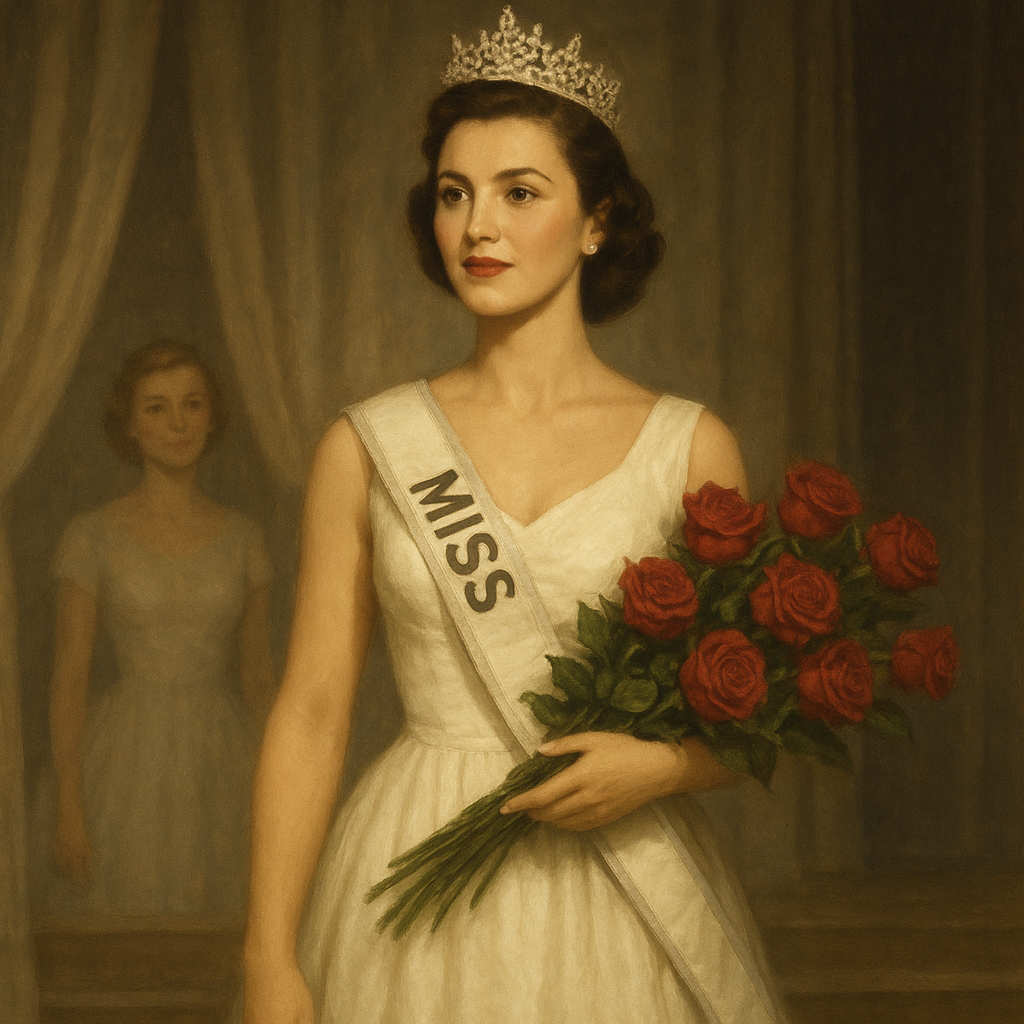
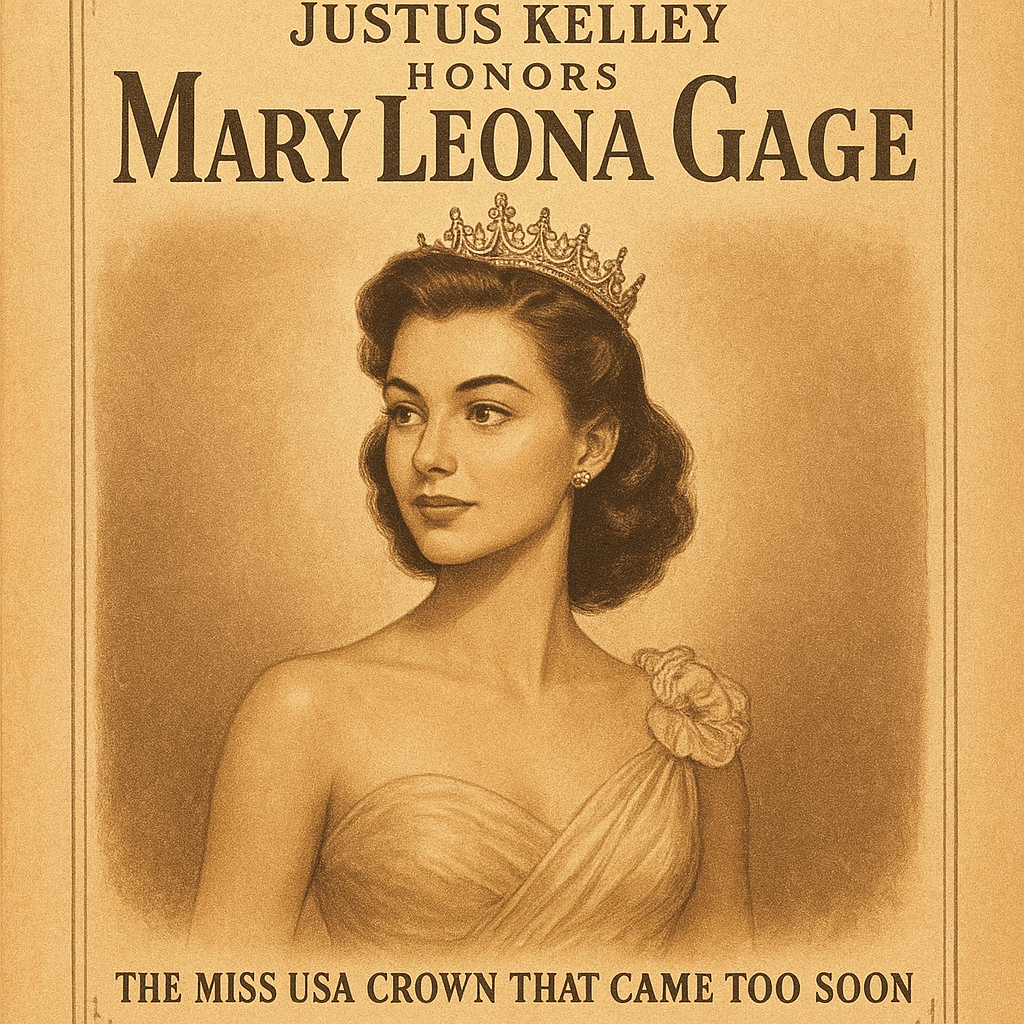
Justus Kelley’s Miss USA departure outfit carried a message beyond pageant glamour: it honored Mary Leona Gage, the 1957 titleholder whose crown was taken after officials learned she was married, a mother, and younger than she had claimed. Kelley’s tribute connects a painful chapter in pageant history with rules that now allow mothers and married women to compete.
Kelley, 31, became the first mother and married woman crowned Miss USA under the modern eligibility rules at the 75th annual pageant on August 27, 2026, according to the report of her win. As she prepared to represent the United States at the Miss Universe final scheduled for November 24, her choice of tribute made the pageant’s past part of her present. The design details of the outfit were not reported, so the significance rests on whom it honored, not speculation about its appearance.
When I compare the two women’s stories, the sharpest point is not that one was right and the other wrong; it is that the institution’s standards changed, while the human stakes of disclosure and judgment remained. Frankly, a crown can make an old rule look official without making its consequences fair. The history deserves a clear account, not a neat slogan.
What Is the Kelley–Gage Miss USA Story?
It is a story about a pageant title, an eligibility rule, and a woman’s attempt to honor someone whose brief reign ended in disgrace. Justus Kelley won Miss USA in 2026 and was preparing to compete at Miss Universe in Puerto Rico when she chose to remember Mary Leona Gage, who had represented Maryland and won the Miss USA crown in 1957. The two women share a striking fact: each was a wife and mother while connected to the title. Their experiences, however, took place under different rules and in very different public climates.
Gage’s case became a scandal because pageant officials learned that she had concealed her marriage and children and had misstated her age. Accounts cited by The Baltimore Sun say she married at 14, had her first child soon afterward, and welcomed a second child at 16. She had told officials she was 21, while she was actually 18. After an investigation, organizers stripped her of the crown. The runner-up, Charlotte Sheffield of Utah, took the title and received the prizes. Historical background on Mary Leona Gage records the same central episode.
The modern change came decades later. In 2022, the Miss Universe Organization announced that married women and mothers would be eligible to compete beginning with the 2023 competition. CNN reported on the policy change, which marked a break from rules that had long excluded contestants in those circumstances. The shift did not erase Gage’s story; it changed the terms under which later contestants could enter.
There is one historical wrinkle worth stating plainly. Kelley is described as the first married mother to be crowned under the changed rules and to hold the title without losing it for that status, but Gage did win the 1957 crown before it was taken away. “First” depends on whether one means first to win temporarily, first to retain the title, or first under the new eligibility policy. That distinction matters. Pageant history is rarely as tidy as a sash.
I see Kelley’s outfit as a deliberate act of remembrance, not a claim that the two experiences were identical. Her reported words to PEOPLE were that Gage “wasn’t allowed to be fully herself” and that the former queen’s title was taken because society was not ready to accept her as a wife and mother. The quote is an interpretation of the past, and it carries emotional weight. It is also a reminder that public image can flatten a person into a single label.
Core Details and Context
The facts are simple. The consequences are not. Gage competed as Miss Maryland in 1957 and won the national title, but her private history became a public matter after the win. Officials investigated and disqualified her after learning about her marriage, children, and age. Sheffield, the runner-up, was awarded the Miss USA crown and its prizes. Gage had already entered the Miss Universe process, and the account says Sheffield could not simply take her place in that international competition.
That last detail shows why a pageant crown is more than a trophy. It is attached to contracts, schedules, eligibility terms, public appearances, and a national representative’s place in an international event. A titleholder can be both an individual and the public face of an organization. When those roles clash, officials reach for written rules, while the public argues about whether the rules themselves were reasonable.
The age issue should not be blurred with the marriage issue. Gage’s claim that she was 21 when she was 18 was a false statement to pageant officials, and organizers had a legitimate interest in whether contestants met their requirements. The marriage and children, by contrast, were characteristics that the modern organization later stopped using as automatic bars to participation. These are distinct matters, even though they converged in one investigation. Here’s the kicker: a rule can be enforced consistently and still deserve reconsideration.
The change did not mean that every applicant automatically qualified. Contestants still had to meet the competition’s other conditions and satisfy its process. Nor did it erase the value pageants place on presentation, public speaking, service, and the ability to represent a title. What changed was a specific boundary around marital and parental status. That is a meaningful reform, but it is not a guarantee that every participant will be treated fairly in every other respect.
Kelley’s public image now rests partly on the history she chose to recognize. Her career as a titleholder will include more than an airport departure look: it includes representing the United States, preparing for an international contest, and speaking about a predecessor whose story might otherwise remain a footnote. Media coverage tends to chase the surprise—the first, the scandal, the outfit—but the deeper question is what the institution learns from its own record.
A fair reading needs both accountability and proportion. Gage gave officials false information, and a pageant organization could reasonably address a breach of its rules. At the same time, a person is more than her public image, her family status, or the worst decision attached to her name. The old Christian instinct to hold truth and mercy together fits here: facts matter, and so does the dignity of the person who lived them. That is not an excuse for deception. It is a warning against reducing a human life to a headline.
Timeline: From Gage’s Crown to Kelley’s Tribute
- 1957: Gage wins Miss USA. Mary Leona Gage represented Maryland and was crowned after the national competition. At the time, pageant eligibility expectations treated marriage and motherhood as disqualifying, though the precise wording of every rule is not reproduced in the available account. She had not disclosed those parts of her life to officials. The title began as a public achievement and quickly became a controversy.
- After the win: Officials investigate. Rumors about Gage’s history circulated, and the organization looked into her background. The investigation found she had married at 14, had two children by 16, and had told officials she was 21 despite being 18. The facts were not interchangeable: the age misstatement concerned her account to organizers, while the marriage and children exposed the era’s eligibility restrictions. She was disqualified and stripped of the crown.
- Sheffield assumes the title. Charlotte Sheffield, Miss Utah and the runner-up, received the Miss USA crown and prizes. Gage had already begun the process of competing internationally, and the account says Sheffield could not step in as her replacement at Miss Universe. The episode left an awkward split between the national title and the international contest. The rules had consequences beyond the ceremony.
- 2022–2023: Eligibility changes. The Miss Universe Organization announced in 2022 that married women and mothers could compete starting in 2023. CNN’s coverage described the change as a first for the competition’s modern rules. That announcement reframed the old Gage episode: the same family status that had helped end her reign no longer automatically barred a contestant from entering. A rulebook had shifted.
- August 27, 2026: Kelley is crowned. Kelley won the 75th annual Miss USA pageant and became the first mother and married woman to hold the title under the new eligibility approach, according to the report. Her win is historically significant, but it should be described carefully because Gage briefly held the crown in 1957 before she was disqualified. Precision does not diminish Kelley’s achievement.
- Departure for Puerto Rico: Kelley makes the tribute. As Kelley left to compete in the 75th Miss Universe pageant, scheduled for November 24 in Puerto Rico, she wore an outfit honoring Gage. Kelley told PEOPLE she thought about the circumstances in which Gage represented the organization. The outfit’s exact design was not reported. The gesture’s meaning was clear enough without inventing details.
I find the sequence more revealing than a simple before-and-after story. A policy changed, a new titleholder stepped forward, and she chose to point backward rather than pretend the past had vanished. That is a strong media moment. It is also a useful reminder that institutional progress is often measured by the people previously excluded.
Comparison: The 1957 Era and the Modern Eligibility Rules
Gage and Kelley were not rivals; they were titleholders separated by nearly seven decades and by a major policy change. The useful comparison is between the conditions surrounding their participation, not a contest over who deserved a crown more. The table separates reported details from broader interpretation, because historical reporting should not fill gaps with confident guesses.
| Point of comparison | Mary Leona Gage, 1957 | Justus Kelley, 2026 |
|---|
| Pageant connection | Represented Maryland and won Miss USA | Won the 75th annual Miss USA pageant |
| Family status | Married and a mother; those facts were concealed from officials | Married and a mother; eligible under the modern rules |
| Age information | Reported as 21 to officials; actually 18 | Age reported as 31 |
| Title outcome | Disqualified and stripped after an investigation | Held the title while preparing for Miss Universe |
| International stage | Had entered the Miss Universe process; Sheffield could not take her place, according to the account | Departed to represent the United States at the scheduled 75th Miss Universe pageant |
| Public meaning | A title ended after disclosure of private facts and rule violations | A titleholder used her platform to honor the earlier queen |
The contrast is not that Gage’s case involved no legitimate concern. She misrepresented her age, and organizers were entitled to investigate whether the information they received was accurate. But a rule excluding married women and mothers treated family status itself as incompatible with the public role. The modern change rejects that automatic exclusion. That is the clearest difference.
The Miss Universe Organization’s official website provides context for the international competition, while the 2022 policy announcement is documented in contemporary news coverage. The organization’s rules can change; old consequences cannot be undone. Kelley’s act of tribute connects those facts without suggesting that she and Gage faced identical tests. A symbol can be powerful and still need careful wording.
The biggest difference, then, is not personality or pageant style. It is institutional permission. Gage’s circumstances were treated as grounds for removal; Kelley’s family status did not prevent her from being crowned under the revised eligibility policy. That difference has practical force: it determines who may enter, who may represent a title, and whose life can be visible without disqualification. Let’s be real, that is the point of the comparison.
Common Misconceptions and What to Know
Misconception one: Kelley was literally the first married mother ever to hold the Miss USA crown. That phrasing skips Gage’s 1957 win. Gage was crowned and then stripped after officials learned what she had concealed, so the most accurate description distinguishes a temporary titleholder from a winner who retained the crown under modern rules. Kelley’s milestone remains important; it simply needs a precise frame. History does not need exaggeration to matter.
Misconception two: Gage lost her title only because she was a wife and mother. The reported account also says she lied about her age. Those facts should not be merged into one vague charge. Her marriage and children exposed the restrictive standards of the period; the age discrepancy was a separate issue involving information given to officials. The investigation and disqualification should be described with both elements in view.
Misconception three: A rule change proves every pageant problem has been solved. It does not. Allowing married women and mothers to compete removes a specific eligibility barrier, but questions about representation, judging, contracts, public scrutiny, and personal privacy remain. One reform can be meaningful without being a cure-all. Pageants still depend on organizations deciding who qualifies and how a titleholder is expected to behave.
Misconception four: Kelley’s tribute means she condemned every official involved in 1957. Her reported comments center on the circumstances under which Gage represented the organization and the social limits placed on a wife and mother. They do not, by themselves, establish what each official knew, intended, or believed. We should not invent motives for people who are not quoted. Skepticism cuts both ways: it questions pageant publicity and it questions our own urge to turn a complicated event into a villain story.
Misconception five: The outfit itself tells the whole story. The report says Kelley wore a departure outfit honoring Gage, but it does not give a full description of its cut, color, or symbols. Those details are not reported here, and adding them would turn a solid story into decoration. The point is the act of honoring an earlier titleholder. The tribute is not a substitute for the history behind it.
Another distinction matters: pageant coverage can celebrate achievement while still scrutinizing institutional rules. Kelley’s win, Gage’s title, Sheffield’s succession, and the eventual eligibility change are not competing truths. They belong in the same account. The truth is, public figures are often treated as symbols before they are treated as people; good reporting puts the person back into the frame and checks each claim against the record.
Frequently Asked Questions
Who is Justus Kelley?
Justus Kelley is the 2026 Miss USA titleholder described in the report as the first mother and married woman to win the title under the modern eligibility rules. She was 31 and was preparing to represent the United States at the 75th Miss Universe pageant in Puerto Rico, scheduled for November 24. Her decision to honor Gage made the older pageant episode part of her public platform. The pageant is only one part of her career, not a complete account of her life.
Why was Mary Leona Gage stripped of her Miss USA crown?
Gage won Miss USA in 1957 representing Maryland, but officials later investigated her background. The account says she concealed that she was married and had two children, and that she told officials she was 21 when she was actually 18. After the investigation, she was disqualified and lost the crown. Charlotte Sheffield, the runner-up from Utah, received the title and prizes.
When did Miss Universe allow married women and mothers to compete?
The Miss Universe Organization announced the change in 2022, with the new eligibility taking effect for the 2023 competition. The policy allowed married women and mothers to compete, ending a long-standing restriction for those groups. It did not mean all other eligibility rules disappeared. CNN’s report on the announcement provides contemporaneous coverage of the change.
What was Kelley’s tribute to Gage?
As she departed for the Miss Universe competition in Puerto Rico, Kelley wore an outfit honoring Gage. Kelley told PEOPLE she had thought about the circumstances in which Gage represented the organization and said the former queen was not allowed to fully embrace her identity as a wife and mother. The outfit’s specific design details were not reported, so its meaning should be described without guessing at its appearance.
The questions point to a broader issue. A title can be awarded by rules, but its meaning is shaped by people who come before and after the winner. Kelley’s choice brought a nearly forgotten chapter into the light. That deserves attention, with the facts kept firmly in view.
A pageant crown is temporary. The standards behind it can last for generations, and they deserve scrutiny when they confuse a woman’s family life with her capacity to represent an organization. Gage’s story includes concealment and a disqualification; it also records an era that treated marriage and motherhood as reasons to close a door. Kelley’s story belongs to a later rulebook, one that made room for her to compete and win.
I would not turn either woman into a perfect emblem. Gage was more than the scandal that ended her reign, and Kelley is more than a historic first or a memorable departure outfit. Their stories meet at a useful point: institutions can enforce rules, reconsider them, and acknowledge those harmed by what they once called normal. A little charity in judgment does not require us to blur facts. It asks us to see the whole person while telling them plainly.
The strongest tribute may be the one that leaves the record intact. Gage won, was investigated, and lost the crown; Kelley won under changed rules and chose to remember her. That is enough to make the contrast powerful. No extra legend is needed.