Jensen Huang on SNL: What the Bowen Yang Sketch Says—and What It Doesn’t
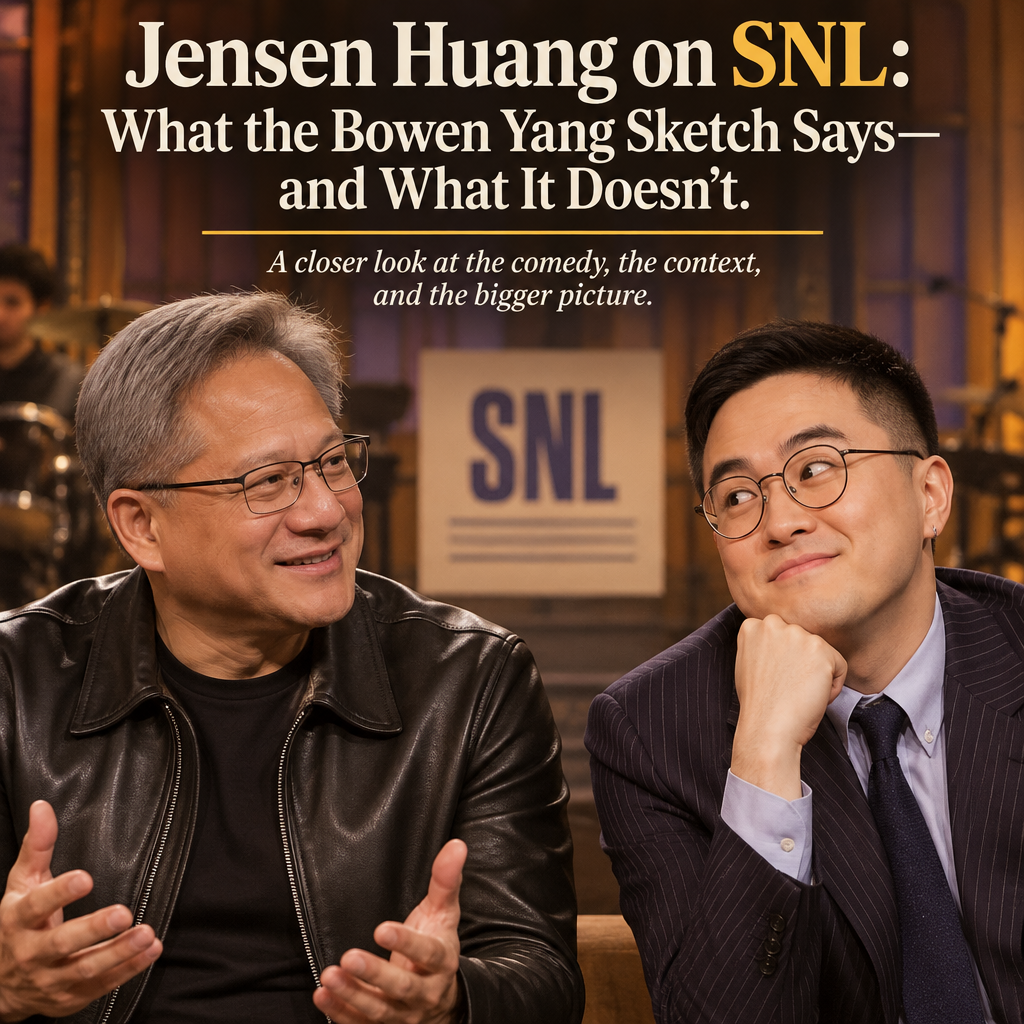
The Jensen Huang joke on Saturday Night Live was a comedy bit, not evidence of a real-world scandal. Bowen Yang’s impression played on Huang’s recognizable leather jacket and Nvidia’s stock-market prominence, while serious claims about affairs, espionage, investigations, and his supposed departure as CEO require credible evidence that has not been established here.
The scene described in connection with John Mulaney’s SNL appearance used the familiar format of a briefing: tech executives are coached on how not to be fooled by spies, and Huang arrives as a comic character with a suggestive nickname and a stock-market gag. That is the joke’s machinery. Its target is the collision of tech power, celebrity branding, and public anxiety about espionage—not a documented finding about Huang’s private life.
That distinction matters because a punchline travels faster than its context. A viewer can remember the leather jacket and the line about the S&P 500, then mistake the surrounding rumor for a confirmed news story. Frankly, that is how flimsy claims acquire the polish of fact. The public record is less dramatic: Nvidia continues to identify Huang as its CEO, and the official materials linked below do not establish the personal or legal allegations repeated alongside the sketch.

What Is the Jensen Huang SNL Sketch?
The sketch is a satirical segment built around a straightforward comic premise: a CIA officer trains technology executives to recognize or avoid spies. John Mulaney plays the officer, while the scene cycles through recognizable names from the technology business, including Sam Altman, Peter Thiel, Mark Zuckerberg, and Dario Amodei. Bowen Yang’s Huang enters in the leather jacket associated with the Nvidia chief and gets the broadest, most deliberately ridiculous treatment.
The reported lines lean on innuendo and market jokes. Huang’s supposed nickname is ‘Hide Your Wife,’ and a line about an invitation becomes a pun on the S&P 500. Another joke expands BDSM into ‘Breaking Da Stock Market.’ This is not restrained character work. It is sketch comedy doing what sketch comedy does: exaggerating a public persona until the silhouette becomes the joke.
The episode listing on NBC’s page for John Mulaney’s SNL appearance helps place the performance in its proper setting. It was an entertainment broadcast, not a deposition, corporate filing, or law-enforcement announcement. Bowen Yang’s resemblance and the recognizable jacket are comic shorthand, not proof that anything in the skit happened outside the studio.
That distinction is especially important when a sketch borrows the language of serious subjects. Intelligence work, foreign influence, and corporate security are real matters; placing them in a comic scene does not confirm a particular spy operation. Nor does a joke about a person’s romantic life establish that person had an affair. The audience is meant to catch the exaggeration, not file it as sworn testimony.
When I assess a celebrity or executive story, I separate three things: what the performance shows, what a publication claims, and what records can verify. Here, the performance is satire. The claims about Huang’s private life and supposed investigations need independent confirmation before they can be repeated as fact. A joke can be sharp and still be a joke. That should not require a legal seminar to understand, but apparently it does.
Core Details: The Joke, the Public Image, and the Claims
- The leather jacket is a recognizable visual cue. Huang’s public appearance is often associated with a black leather jacket, so Yang’s costume immediately signals the subject to viewers. It also turns a real executive’s style into a stage prop. That is standard impersonation, not evidence of hidden conduct.
- The market joke draws on Nvidia’s public profile. Nvidia has become one of the most visible technology companies because of its chips and the enormous attention paid to artificial intelligence. A stock-market punchline lands because the company’s valuation and influence are already part of public conversation. The joke does not show that Huang personally manipulated markets or made a particular investment claim.
- The spy-training premise is fictional framing. A CIA officer explaining how executives might avoid being duped is a handy setup for parody. It is not, by itself, a report of an actual intelligence briefing or a named espionage case.
- The alleged affair and spy connection remain unverified. No official company statement, court filing, or named law-enforcement announcement cited here establishes the claims. The allegations should not be promoted from rumor to fact because they appear beside a real person’s name in a comic recap.
- The CEO-departure claim conflicts with Nvidia’s own public information. Nvidia’s leadership page lists Huang as president and CEO. Its official biography also describes his role at the company. Those company pages are not a complete account of every private matter, but they are clear evidence against the claim that he has stepped down.
Here’s the kicker: the scandal claims are not necessary to explain the sketch. The humor works without them. A leather-jacketed executive, a CIA classroom, and a pun about breaking the stock market already give the writers enough material. Adding an unconfirmed affair or spy story may make a recap sound juicier, but it also changes the reader’s impression of a real person without supplying proof.
The same caution applies to claims of an internal investigation, a class-action lawsuit, or an FBI inquiry. Each should be checkable in a different way: a company announcement or filing for an internal matter, a named court and case number for litigation, and an on-record statement or reliable report for a federal investigation. A responsible account supplies those details. If they are missing, the careful description is that the claims are unsubstantiated—not that they are established facts.
There is a basic human point here, too. A public figure is more than a jacket, a stock ticker, or a rumor; charity in judgment is not the same as gullibility. It simply means not treating someone’s dignity as disposable because a spicy headline or a good punchline is available.
Timeline: What Happened, and What the Claims Do Not Prove
- John Mulaney hosted SNL. NBC’s episode listing places his appearance in the show’s 50th season, with Lady Gaga as musical guest. That establishes the broadcast context. It does not establish the truth of any private-life claim later attached to the performance.
- The sketch used a technology-and-spies setup. Mulaney’s character reportedly coaches tech leaders on avoiding deception by spies. The scene’s premise puts corporate power and intelligence fears together, an easy target for satire. A fictional briefing is still fictional, even if it borrows real names.
- Bowen Yang played a comic version of Huang. The leather jacket and exaggerated lines made the impersonation legible. The stock-market wordplay was part of the performance. It was not a corporate disclosure from Nvidia, and it was not a statement from Huang.
- A recap attached personal allegations to the sketch. Claims about affairs, a suspected spy, an employee message, investigations, and a lawsuit appeared in the account of the comedy bit. Each claim needs its own evidence. Their proximity to a sketch does not provide that evidence.
- The CEO claim can be checked against company records. Nvidia’s public leadership materials continue to identify Huang as president and CEO. The company’s investor-relations area also provides official financial and filing materials. Those records are more useful for checking his corporate position than a comedic character or a gossip-style claim.
- The responsible reading is narrower than the rumor. The sketch mocked a public executive through a recognizable costume and broad jokes. The official sources listed here do not substantiate the alleged personal or criminal story. Until credible documentation appears, readers should keep the joke and the allegations in separate boxes.
I find the sequence matters because viral recaps often reverse it: they lead with the rumor, then present the comedy clip as if it were corroboration. It is not. A television sketch can repeat a familiar claim, invent a detail, or build a character out of exaggeration; none of those choices turns the scene into independent reporting. The date of a broadcast tells us when the performance happened, not whether a separate allegation is true.
Comparison Table: SNL’s Character Versus the Public Record
There is no sensible way to compare a private-life rumor with a rival person as though both were competing products. The useful comparison is between the comic portrayal and the verifiable public record. That is where the difference becomes plain.
| Point of comparison | SNL portrayal | Public record or responsible reading |
|---|
| Who plays Huang | Bowen Yang performs a comic impersonation. | An actor’s portrayal is not an official statement by Huang or Nvidia. |
| Costume and persona | The leather jacket and nickname make the character instantly recognizable. | A public image can be parodied without proving anything about private behavior. |
| Stock-market line | The S&P 500 and ‘Breaking Da Stock Market’ supply the punchline. | Nvidia’s market prominence explains why the joke lands; it does not confirm misconduct. |
| Spy premise | A CIA training scene provides the sketch’s frame. | The scene is satire, not evidence of an actual investigation or spy relationship. |
| CEO status | The sketch treats Huang as a recognizable technology executive. | Nvidia’s leadership page lists him as president and CEO, contradicting the claim that he stepped down. |
| Allegations | The surrounding gossip makes the sketch sound like part of a scandal. | No supporting court record, company notice, or named official source is established by the cited materials. |
The contrast is not subtle. Comedy compresses reality into a quick visual and a laugh; reporting has to show its work. A performer can signal ‘Huang’ with a jacket and a line about markets. A journalist making claims about a person’s marriage, an alleged foreign agent, or federal investigators needs documents, named sources, and careful qualification. The evidence standard is different because the consequences are different.
If a reader wants a business comparison, Nvidia’s major competitors belong in a separate article about semiconductors, products, and market share. They do not help verify a personal allegation. Mixing those subjects just makes the story noisier. The table above stays on the question that matters here: what did the audience see, and what can public records actually support?
Common Misconceptions: What Viewers Should Know
Misconception: If SNL joked about it, the underlying story must be true. No. Comedy writers use public events, rumors, exaggerations, and invented scenarios. A sketch can be inspired by a news story, but inspiration is not verification. The clip itself cannot confirm an affair or an investigation unless it is explicitly reporting evidence—and a comedy segment is not doing that.
Misconception: A convincing impersonation signals inside knowledge. It does not. Costume, posture, voice, and catchphrases help viewers identify the person being mocked. They tell us about the performer’s choices and the audience’s familiarity with the subject. They do not tell us what happened in a private relationship or a government inquiry.
Misconception: The allegations are confirmed because several dramatic claims appear together. A pile of claims is not a pile of evidence. An alleged affair, a supposed spy connection, a company investigation, a lawsuit, and FBI interest are separate propositions. Each requires its own confirmation. Repeating them in one paragraph can make them feel mutually reinforcing, though one does not prove another.
Misconception: Huang stepped down as CEO. Nvidia’s published leadership information says otherwise: it identifies him as president and CEO. Readers can check the company’s leadership page and its SEC filing record. If a change in leadership occurs, investors should expect formal company and regulatory information, not just a claim attached to a sketch.
Misconception: A lawsuit or FBI inquiry can be asserted without a case number or official source. For a lawsuit, look for the court, filing date, named parties, and complaint. For a federal investigation, look for a named official, an official statement, or credible reporting that identifies the basis for the claim. Not every investigation is public, of course, but that is precisely why a writer must not present a rumor as confirmed.
Let’s be real: readers are not required to treat every rumor as a courtroom filing. They are required to notice when a story gives them no way to check its biggest claims. A careful reader asks who said it, what document backs it, and whether the source is reporting or riffing. That small pause can prevent a punchline from being mistaken for a damaging fact.
Frequently Asked Questions
Did Bowen Yang play Jensen Huang on SNL?
The sketch described in coverage of John Mulaney’s SNL appearance features Bowen Yang portraying Huang in a satirical technology-executive scene. NBC’s episode listing verifies the broadcast context. The details of the performance should be understood as comedy, not as a factual account of Huang’s private affairs or any intelligence investigation.
Did Jensen Huang step down as Nvidia CEO?
Nvidia’s official leadership page lists Huang as president and CEO. The company’s official biography likewise describes his leadership role. Those sources do not support the claim that he has stepped down. For an important change in executive status, readers should look for an announcement from Nvidia or its filings with regulators.
Are the affair and suspected-spy claims confirmed?
The materials cited in this article do not establish those allegations. No named court filing, company notice, or official law-enforcement statement here confirms them. They should therefore be described as unverified claims, not facts. A comedy sketch or a recap repeating an allegation is not independent confirmation.
Is the FBI investigating Huang?
No FBI investigation is established by the official sources cited here. A claim of federal involvement is serious and should be backed by an attributable statement or strong, independently verified reporting. Without that, the responsible answer is that the claim is not confirmed—not that an investigation is underway.
Final Thought
The sketch’s joke is easy to understand: take a powerful technology executive, give him a signature jacket, place him in a spy-training room, and let the writers push the persona into absurdity. Bowen Yang’s performance can be funny, sharp, or too broad, depending on the viewer. None of those reactions changes the basic category of the material. It is satire, not a sworn account of Huang’s conduct.
The harder part is resisting the extra story bolted onto the joke. Claims about affairs, foreign espionage, corporate inquiries, lawsuits, and federal investigators carry consequences beyond a laugh. They can damage reputations and mislead readers, particularly when written with the confidence of a confirmed report but without the documents a confirmed report should have. Sensational phrasing is not sourcing. Repetition is not proof.
When I compare the account with Nvidia’s public leadership materials, one point is clear: the claim that Huang stepped down does not match the company’s published record. The other allegations need stronger evidence before they deserve a factual headline. For now, readers can enjoy—or dislike—the impersonation while declining to treat its surrounding gossip as established truth. A person is not reducible to a meme, a stock symbol, or a rumor. That is not softness; it is the minimum standard for fair judgment.