The nationwide FAA ground stop was lifted Friday night. At the press conference that followed, DHS Secretary Markwayne Mullin described new equipment and...
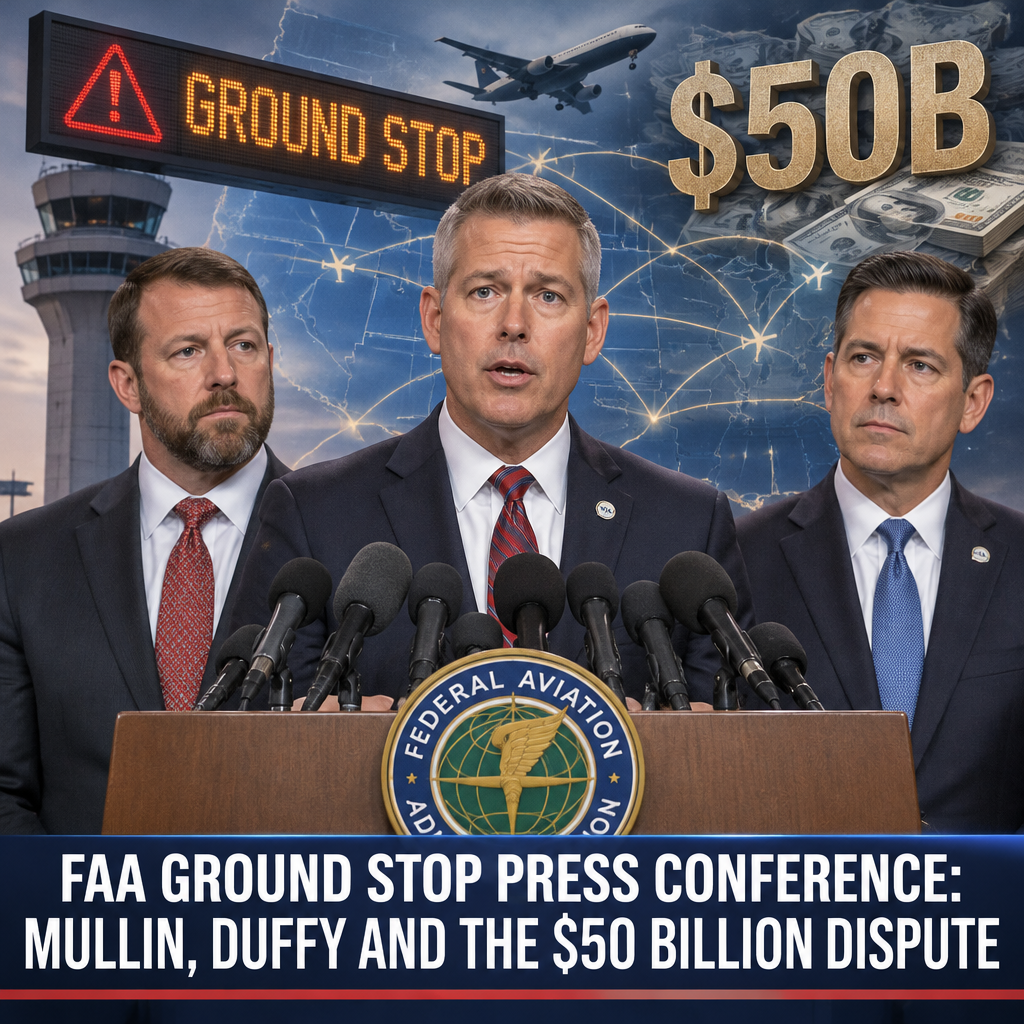
FAA Ground Stop Press Conference: Mullin, Duffy and the $50 Billion Dispute
The nationwide FAA ground stop was lifted Friday night. At the press conference that followed, DHS Secretary Markwayne Mullin described new equipment and software patches as overwhelming an older system, while Transportation Secretary Sean Duffy blamed legacy equipment and urged Congress to provide $50 billion. The precise technical cause was not established in the account.
Key Takeaways- The FAA lifted the ground stop Friday night.
- Mullin and Duffy offered explanations that emphasized different parts of the equipment problem.
- Duffy asked Congress for $50 billion in emergency funding.
- FAA Administrator Bryan Bedford reportedly said 12,000 flights were “lost,” but the account does not define that figure.
- The briefing raised questions about accountability, infrastructure, and what officials can responsibly claim before an investigation is complete.
The awkward moment was not just a clash of personalities. It showed how quickly a public explanation can outrun the facts when a complex technical failure is still being assessed, and when several federal agencies share responsibility for the response. Mullin was asked whether a cyberattack caused the “extraordinary circumstances” behind the malfunction. He described system patches, new equipment, and older technology, but that answer did not establish a final cause or rule out every other possibility.
Duffy’s argument had a different emphasis: the aging equipment itself was the problem, and Congress should act before another failure. At Saturday’s briefing, Bedford reportedly put the disruption at 12,000 flights, while Duffy and the FAA administrator appeared to interrupt one another. Here’s the kicker: a large number without a clear definition does not tell travelers whether flights were canceled, delayed, diverted, or counted in some other way. That distinction matters.
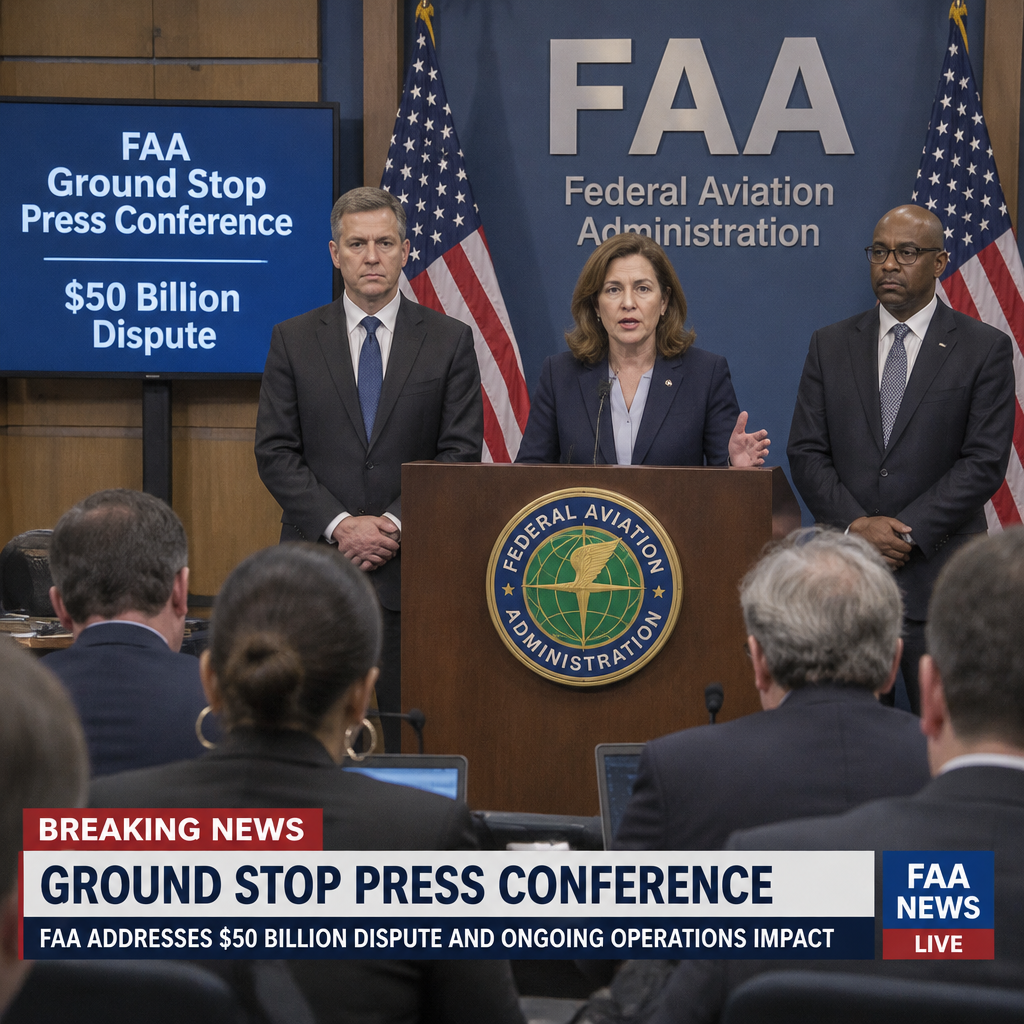
What happened at the FAA ground stop press conference?
A ground stop is an air traffic measure that holds aircraft at their departure points, usually to manage a safety or operational problem affecting a destination or a wider part of the system. It is not the same thing as saying every airport has closed, and it does not, by itself, identify what caused the problem. In this case, the nationwide stop was lifted Friday night, according to the account of the event.
The press conference became a story in its own right because the officials’ explanations did not land neatly together. Mullin, the secretary of Homeland Security, was asked about the possibility of a cyberattack. His answer focused on patches and new technology being introduced into an older system, which he said appeared to be overwhelmed. Duffy, the transportation secretary, emphasized “old legacy equipment” and called for emergency money from Congress. Those ideas may overlap: new components interacting poorly with old infrastructure is not the same claim as saying the new equipment alone caused a failure. But the difference in emphasis was obvious on camera.
I read the exchange as a conflict over framing more than a proven dispute over engineering. One official described a system under strain during upgrades; another stressed the hazards of aging equipment and the need for investment. Neither description, as reported, came with a public technical report, a detailed timeline of the malfunction, or a documented finding that settled the root cause. The visual awkwardness—Duffy lowering his head, shaking it, and possibly nudging Mullin—may make a compelling clip, but it cannot substitute for evidence about what happened inside the system.
The distinction between an initial account and a verified cause is basic but often lost in breaking news. A press conference can tell the public what officials believe, what they are asking for, and what they are prepared to say. It does not automatically provide the underlying logs, engineering review, or independent analysis needed to establish causation. The FAA’s newsroom and air traffic information pages are useful places to check for official updates, but readers should look for specific documents rather than assume a general agency page confirms every detail of a developing event.
There is also a human cost behind the machinery. A ground stop can leave travelers stranded, crews out of position, and families scrambling to change plans. That deserves attention without turning every uncomfortable expression at a podium into proof of malice or incompetence. People are more than their public image, and public officials deserve scrutiny for their decisions—not a shortcut verdict based on one awkward moment.
Core details and context
Several separate questions are tangled together in the account. Keeping them apart makes the story clearer and prevents a sound bite from being mistaken for a completed investigation.
- What triggered the stop? Officials described “extraordinary circumstances” and a system malfunction. The account does not provide the exact technical failure, which system component was involved, or a formal incident report. Until those details are published, a confident claim about the precise trigger would be premature.
- Was a cyberattack responsible? Mullin was asked about that possibility. His answer described equipment and patches; it did not, as reported, present forensic evidence proving that an attack happened or definitively ruling one out. A question about cyber risk is not evidence of a cyberattack.
- What did Mullin say about upgrades? He said that, as Duffy and the FAA were installing patches and new equipment, the new technology appeared to overwhelm the older system. That is a description of his understanding at the time, not necessarily the FAA’s final technical finding.
- What did Duffy say? He pointed to old legacy equipment and warned that more incidents could occur. He also urged Congress to provide $50 billion in emergency funding, calling the request bipartisan and a matter of national interest. The account does not break down how that amount would be spent.
- What did Bedford report? The FAA administrator reportedly said 12,000 flights had been “lost” the previous day. That wording needs careful handling: the account does not say whether the number refers to cancellations, delays, all affected flights, or another measure. It should not be read as 12,000 aircraft disappearing.
- What happened after the stop? The FAA lifted it Friday night. Duffy and Bedford spoke with the press Saturday, and the account describes a tense exchange in which Bedford interrupted Duffy multiple times. The transcript and operational records would help establish the exact sequence and wording.
Frankly, the most consequential part may be less theatrical than the head-shaking. Aging equipment, software changes, testing procedures, staffing, funding, and oversight can all affect reliability, but the report does not establish which factor caused this malfunction. A credible investigation would distinguish the immediate technical fault from the conditions that allowed it to matter. It would also explain what safeguards worked, what did not, and what changes are already underway.
The agencies’ own public channels can help readers track new statements. The FAA newsroom is a place to check for agency announcements, while the Department of Transportation briefing room and the Department of Homeland Security newsroom publish statements from the departments involved. Those are primary-source channels, not proof that every reported detail has been confirmed. A careful reader should look for dated releases, named findings, and underlying documents.
Duffy’s funding demand also deserves more than a reflexive yes or no. A large request may reflect urgent infrastructure needs, but a round number at a podium is not a spending plan. Congress would need to examine the purpose, schedule, oversight, and expected results. Conversely, rejecting a request simply because it arrived during a crisis would be just as lazy. The right question is what specific improvements the money would buy, how quickly they could be delivered, and how taxpayers would know whether they worked.
Timeline: how the story unfolded
- A nationwide ground stop takes effect. The event was described as an FAA action under “extraordinary circumstances.” The account does not identify the precise start time, affected airports, or operational trigger. That missing detail limits any attempt to reconstruct the disruption minute by minute.
- The FAA lifts the stop Friday night. That marks the end of the immediate nationwide restriction, not necessarily the end of delays, schedule changes, or technical review. Resuming operations and understanding the cause are separate tasks.
- Mullin is asked about a cyberattack. He responds by describing patches and new equipment being introduced into an older system. He says the new technology appeared to overwhelm the older setup, but the account provides no technical evidence accompanying that explanation.
- Duffy reacts during Mullin’s answer. The account describes Duffy lowering his head and shaking it, with a possible nudge from behind the podium. The gesture is reported as a possible physical cue, not a confirmed account of what he intended. Body language can suggest tension; it cannot establish the cause of a system failure.
- Duffy points to legacy equipment and asks for funding. He calls the situation an emergency and requests $50 billion from Congress. He warns that more incidents may occur, though the account does not include a forecast, supporting analysis, or detailed spending breakdown.
- Duffy and Bedford speak Saturday. Bedford reportedly says 12,000 flights were “lost” the previous day. Duffy and Bedford interrupt one another, adding visible tension to the briefing. Without a definition of “lost,” the number is not enough to calculate cancellations or delays.
- Agencies are approached for comment. The report says the Department of Transportation had not responded at that point, while DHS shared a press release about the conference. That describes the response at the time of reporting; it does not establish what either department said later.
When I track a developing government story, I separate what happened from what officials infer about it. Here, the stop was lifted; officials gave public explanations; Duffy requested money; Bedford reported a large flight figure. The exact technical cause remains a different question. It is an unglamorous distinction, but it is the difference between reporting a statement and announcing a finding.
Mullin’s explanation versus Duffy’s explanation
These are competing emphases, not necessarily mutually exclusive technical conclusions. Mullin described new equipment and patches placing a load on an older system. Duffy focused on the old legacy equipment itself. The available account does not give enough technical detail to decide whether one description is right, whether both capture different parts of the same failure, or whether later findings will point elsewhere.
| Issue | Markwayne Mullin’s reported framing | Sean Duffy’s reported framing |
|---|
| Main focus | Patches and new equipment interacting with an older system | Aging or “old legacy” equipment |
| Explanation offered | New technology appeared to overwhelm the older system | Legacy equipment was to blame for the error |
| Funding request | No specific request is reported in his answer | Asked Congress for $50 billion in emergency funding |
| Cyberattack question | Answered by discussing equipment; no forensic finding is reported | The account does not report a separate cyberattack conclusion from Duffy |
| Evidence described | No technical report or system logs are included in the account | No cost breakdown or technical report is included in the account |
| Status of claim | Initial explanation, not shown as a final finding | Public explanation and funding argument, not shown as a final finding |
The table should not be treated as a scorecard. Mullin’s description does not prove that the upgrades caused the malfunction, and Duffy’s description does not prove that old hardware was the sole cause. Equipment failures can involve interactions among components, maintenance, software, procedures, and operating conditions. Without a published analysis, the cleanest conclusion is that the officials emphasized different causes while the technical account remained incomplete.
There is a political incentive in both framings. An explanation centered on upgrades can direct attention toward how changes were implemented; a focus on legacy hardware can strengthen the case for investment. That observation is not an accusation of dishonesty. It is a reason to ask for evidence that can test each claim. The transportation secretary’s request may be justified, but it must stand on documented need, not merely on the force of a dramatic briefing.
The public deserves the sequence of events, the exact system affected, the duration and scope of the disruption, the flight-count methodology, and the corrective steps. The FAA’s air traffic information can provide general operational context; a specific incident report would be more useful for determining what failed here. If agencies later publish a technical review, that document—not a grimace, a slogan, or a funding figure—should anchor the final account.
Common misconceptions and what to know
Misconception: a ground stop proves the entire air traffic system failed. Not necessarily. A ground stop is an operational measure, and its geographic reach or duration does not by itself explain the underlying problem. The account calls this one nationwide, but it does not identify every affected airport or describe the technical scope. Those particulars matter when assessing the scale of an event.
Misconception: Mullin’s answer confirms a cyberattack. It does not. He was asked whether an attack was responsible and responded with an explanation involving patches, new equipment, and older technology. That is not the same as saying investigators found malicious access. Nor does the reported answer establish that an attack was ruled out. The responsible position is to wait for a clear finding.
Misconception: Duffy and Mullin necessarily contradicted each other. Their comments emphasized different parts of the system, but the ideas could be compatible. New components can interact badly with older infrastructure, while an aging system can be vulnerable to upgrades or operational strain. The account does not supply enough engineering detail to settle that question. Treating a difference in emphasis as proof of a personal feud makes for easy gossip and weak analysis.
Misconception: 12,000 flights were literally lost. Bedford’s reported wording is striking, but the account does not define it. A flight might be delayed, canceled, diverted, or otherwise affected; a count could include one or more of those categories. Until the FAA explains the measure, readers should not convert an ambiguous phrase into a precise number of cancellations. If the figure is later clarified, the definition should travel with the number.
Misconception: $50 billion is self-explanatory. It is not. Duffy made an urgent funding appeal and tied his warning to old equipment, but the account does not list programs, projects, timelines, or oversight provisions. Congress should ask what work is proposed, what is already funded, how costs were estimated, and how progress will be measured. That is not obstruction; it is the ordinary duty attached to public money.
Misconception: awkward body language proves a private feud. A lowered head, a shake of the head, or a possible nudge may look telling in a short clip. But viewers cannot reliably infer motive from a gesture alone, especially when officials are sharing a podium during a stressful briefing. The reaction is relevant to how the message landed, not evidence of what either secretary privately believes.
Let’s be real: the most shareable moment is often the least useful one. The tense exchange raises a fair question about how senior officials coordinate public explanations during a crisis. It does not answer whether the FAA’s equipment, a patch, a procedure, a cyber event, or some combination caused the malfunction. Accountability means pressing for records and clear answers, not choosing a villain before the facts arrive.
Frequently asked questions
What caused the nationwide FAA ground stop?
The account describes a system malfunction and reports that Mullin discussed patches and new equipment interacting with older technology, while Duffy blamed legacy equipment. It does not include a final FAA technical finding. The confirmed cause should therefore be described as not established in the account, rather than assigned to one official’s explanation.
Did officials confirm a cyberattack?
No confirmation is reported. Mullin was asked about the possibility and answered by describing equipment and system changes. That answer does not provide forensic proof of an attack, and it does not clearly state that investigators ruled one out. A definitive answer would require a documented finding from the relevant authorities.
What did Duffy mean by asking for $50 billion?
He called for Congress to provide $50 billion in emergency funding and connected his appeal to aging equipment and the risk of further incidents. The account does not provide a detailed budget or explain how the money would be allocated. The request is a political and policy proposal, not evidence by itself that a specific amount is necessary.
What does the reported 12,000-flight figure mean?
Bedford reportedly said 12,000 flights had been “lost” the previous day, but the account does not define the term. It could refer to flights affected in several ways; it should not be presented as 12,000 canceled flights unless an official breakdown confirms that interpretation. The FAA’s methodology and categories are essential to understanding the number.
Final thought
The ground stop is a serious public event, and the awkward press conference is a useful window into how government officials communicate under pressure. But the footage and the sound bites are only the top layer. The public still needs a clear account of the malfunction, an explanation of the flight figure, and a transparent assessment of whether older equipment, recent changes, or another factor played a decisive role.
Duffy may be right that the FAA needs urgent investment. Mullin may have accurately described a system strained by new technology meeting old infrastructure. Both statements may contain part of the truth, or later evidence may show that one or both were incomplete. The right test is not which official looked more confident at the podium. It is whether the agencies can publish evidence, explain uncertainties plainly, and show what they will change.
There is no need to turn a public servant into either a hero or a villain before the record is complete. Human beings can be capable and fallible at once, and a fair assessment should leave room for both accountability and proportion. That means asking hard questions without pretending that a tense exchange settles them. In this story, the next meaningful development is not another reaction shot; it is the technical explanation that can be checked.