Conor Kennedy’s Rio Wedding: A Brazilian Pop Star, a Kennedy Name, and the Facts We Know
Conor Kennedy’s reported wedding celebration in Rio de Janeiro brings together two subjects the public tends to watch closely: the Kennedy family and celebrity romance. Kennedy, son of Robert F. Kennedy Jr., celebrated with Brazilian pop star Giulia Be, according to the supplied report. The striking setting makes an easy headline; the more useful story is how a private milestone becomes public news—and why readers should separate confirmed details from decoration.
What Is the Conor Kennedy and Giulia Be Wedding Story?
At its simplest, this is a celebrity wedding story: Conor Kennedy, a member of the well-known Kennedy family, reportedly celebrated a wedding with Brazilian pop star Giulia Be in Rio de Janeiro. That summary is enough to explain the headline’s appeal. It joins an American political family, a music career with an international audience, and a city whose name carries a vivid sense of place.
But the headline is not a full wedding announcement. The information supplied here does not name the date, exact venue, officiant, guest list, or whether the celebration followed an earlier legal ceremony. Those details matter. A wedding can include a civil registration, a religious service, a private family gathering, and a larger celebration on different days. Treating all of those as one event can produce a tidy story that is simply wrong.
Conor Kennedy is the son of Robert F. Kennedy Jr. and belongs to a family whose name has been attached to American political life for generations. For background on his father, readers can consult Britannica’s biography of Robert F. Kennedy Jr. Giulia Be is a Brazilian singer and songwriter; her identity as an artist matters here because this is not only a story about a famous family, but also about a musician with her own career and public image.
I see the same trap in celebrity coverage again and again: the famous relative becomes the whole plot. That framing is convenient, but it shrinks both people involved. A marriage is not a political endorsement, a publicity stunt, or an accessory to a surname. It is a personal commitment, even when cameras and headlines gather around it.
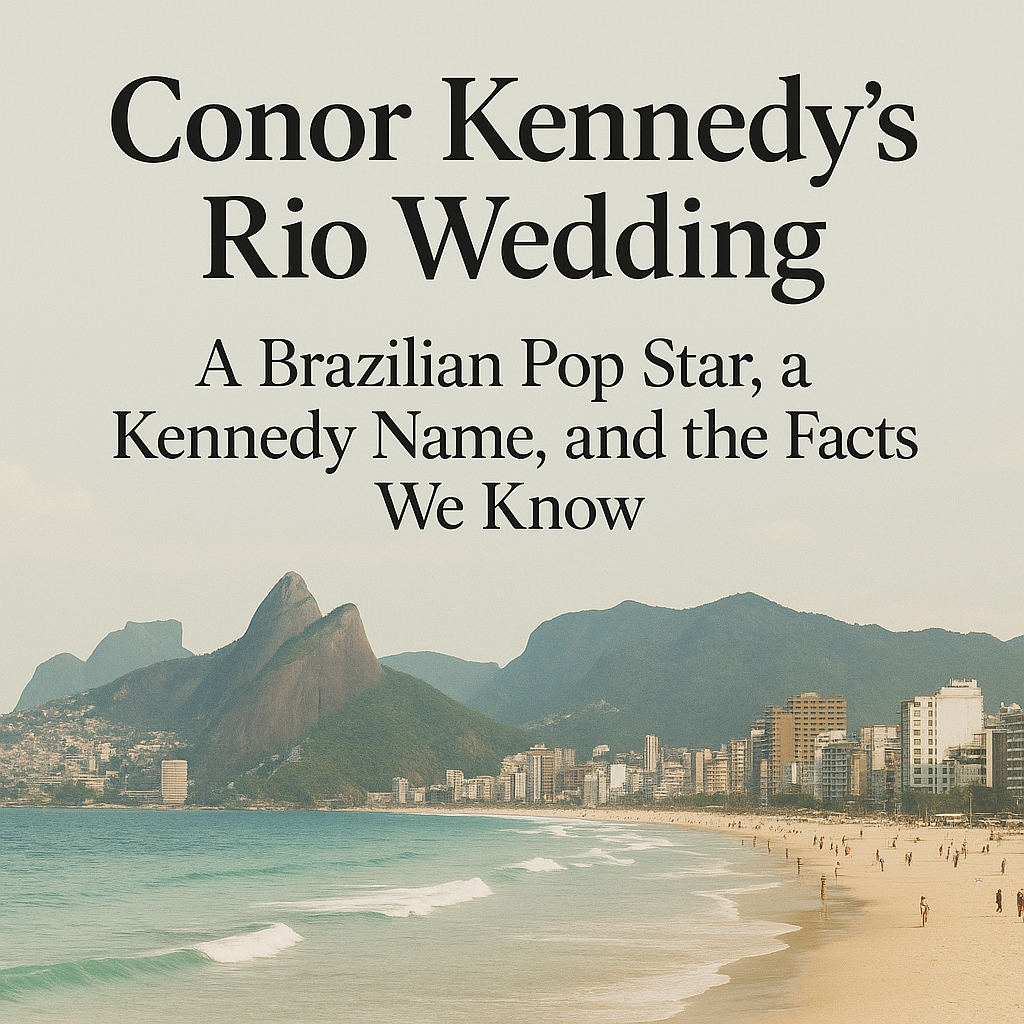
Rio de Janeiro adds a strong visual frame. The city is known internationally for its coastline, architecture, music, and layered urban life, so “Rio setting” naturally sounds cinematic. Still, scenery is not evidence about what happened at a ceremony. A gorgeous backdrop can be reported as context; it should not become a license to invent details.
Core Details and Context
The available story contains a few clear points and several blanks. That is not a problem; it is a reason to report carefully. Here is what readers can take from the headline without turning guesses into facts:
- The people: Conor Kennedy and Brazilian pop star Giulia Be are the subjects of the wedding report. The headline identifies Kennedy through his father, RFK Jr., but Giulia’s own career deserves equal attention.
- The event: The report describes a wedding celebration. It does not establish whether this was the couple’s only ceremony, a reception, or a celebration after a legal marriage elsewhere.
- The setting: Rio de Janeiro is named as the location. The precise venue is not given in the supplied material.
- The public interest: Kennedy’s family name brings political and historical associations; Giulia Be’s music career brings an entertainment audience. The combination crosses the usual categories of celebrity news.
- The limits: No verified details about the guest list, clothing, vows, or schedule appear in the supplied headline. Readers should wait for reliable reporting or direct statements before repeating such claims.
Frankly, the grandest language in wedding headlines often describes the photograph, not the marriage. “Gorgeous” is a visual judgment, not a fact about the couple’s relationship. Rio may indeed offer a remarkable setting, but the headline alone does not tell us what the venue looked like, what traditions were observed, or who attended.
The Kennedy name also invites a historical detour. Robert F. Kennedy, Conor’s grandfather, was a U.S. senator and presidential candidate whose life and assassination became part of American public memory. A short account of his career is available in Britannica’s biography of Robert F. Kennedy. That history can explain why the family attracts attention, but it should not overwhelm the present story. Conor is not a stand-in for his grandfather, and a wedding is not a chapter in a family legend written by strangers.
Giulia Be should not be reduced to “the Brazilian pop star” either. That phrase is a quick identifier, not a career summary. A musician’s work includes songwriting, recording, performance, and the decisions that shape a public image. Coverage that treats her solely as someone’s bride misses the obvious: she arrives in the story as a public figure in her own right.
I have tracked enough celebrity coverage to know how quickly a small factual base gets buried under confident adjectives. The sensible approach is plain: report the couple, the reported celebration, and Rio; label anything else unconfirmed unless dependable sources establish it. That is less breathless, perhaps, but much more useful.

Timeline: What We Can Say Without Guessing
A careful timeline does not fill blanks with imagination. It marks the known information and says where the record stops.
- Before the wedding report: Conor Kennedy was already publicly known as a member of the Kennedy family, while Giulia Be had her own identity as a Brazilian music artist. Their public profiles developed in different worlds, which helps explain why news of their pairing attracted attention.
- The relationship enters public coverage: The supplied headline treats the two as a couple celebrating a wedding. It does not provide a chronology of their relationship, explain how they met, or establish when they became engaged. Those details should not be supplied from guesswork.
- A wedding celebration is reported: The headline says Kennedy celebrated a wedding with Giulia Be in Rio de Janeiro. That is the central reported event. It does not give a date or precise location within the city.
- The story spreads: The supplied text says the story had been shared 15,927 times. That figure is a snapshot associated with the original post or report, not a measure of public approval, the size of the wedding, or the couple’s fame in any rigorous sense.
- The unanswered questions remain unanswered: Without an identified source for ceremony particulars, the guest list, the vows, and the exact venue remain outside the confirmed account provided here.
Here’s the kicker: a share count is easy to mistake for proof that a story has been independently verified. It is not. It tells us that users passed the item along, or that a platform recorded shares, depending on how the number was collected. It says nothing about whether every detail in the accompanying copy has been checked.
The same caution applies to photographs and social posts. A couple may choose to share selected images; a guest may post a view of the celebration; a publication may report a location. Each can provide evidence, but context matters. An image can show a dress or a room without proving the date, legal status, or full guest list. A caption can be playful rather than a formal announcement.
I would treat the order of events as provisional until the couple or a reliable outlet supplies a fuller account. That is not cynicism for sport. It is basic source discipline. When a story concerns people rather than fictional characters, inaccurate details can follow them long after the news cycle moves on.
Comparison: This Wedding Story and the Usual Celebrity Wedding Cycle
There is no direct “competitor” to a wedding, and no performance data was included in the supplied material. The useful comparison is between this cross-border celebrity story and the standard celebrity wedding headline. The table below contrasts their coverage patterns, not the couple’s private choices.
| Feature | Kennedy–Giulia Be report | Typical celebrity wedding coverage |
|---|
| Main hook | A Kennedy family connection, a Brazilian pop star, and a Rio setting | A famous couple, a striking venue, or a star-studded guest list |
| Confirmed details in the supplied text | Wedding celebration, Conor Kennedy, Giulia Be, Rio de Janeiro | Varies by report; often a date, venue, photos, or official announcement |
| Audience overlap | Politics and celebrity news meet music and international readership | Usually concentrated in entertainment and celebrity coverage |
| Common risk | Allowing the Kennedy surname to eclipse Giulia’s career or the couple’s privacy | Treating one image or anonymous tip as a complete account |
| Best editorial practice | Attribute the report and avoid adding ceremony details not provided | Verify names, dates, sources, and the couple’s own statements |
| What a share count means | A reported number of shares, not proof of accuracy or popularity | A distribution signal, not a measure of truth |
The cross-border dimension gives this item an extra angle. A U.S. political family and a Brazilian performer attract readers who may not ordinarily follow the same outlets. That overlap is real editorially, but it does not turn the story into a referendum on politics, national identity, or the music business. It remains, first, a personal milestone reported in public.
Let’s be real: the celebrity wedding template is predictable. Readers are offered a setting, clothes, famous guests, and a neat “fairytale” label. Those pieces can make a lively feature, but they are not the same as meaningful knowledge about a relationship. A polished image tells us how a moment was presented; it does not disclose the private work of building a life together.
The more interesting comparison is not whose wedding was bigger. It is how coverage handles the people involved. Does it treat Giulia Be as an artist with her own achievements? Does it avoid turning Conor into nothing but a Kennedy descendant? Does it distinguish a reported detail from a confirmed one? Those questions separate competent entertainment writing from a scrapbook of assumptions.
A wedding story can be warm without becoming syrupy. It can note the pleasure of a celebration and the beauty of a setting while respecting the fact that the couple’s inner life is not ours to inspect. That balance is not prudish. It is simply a recognition that public visibility does not erase human dignity.
Common Misconceptions and What to Know
Misconception one: the headline tells us everything about the wedding. It does not. The headline names the couple and the city, then characterizes the setting as gorgeous. It offers no precise date, venue, ceremony format, or list of attendees. Anyone adding those details should show a reliable source.
Misconception two: being a Kennedy makes Conor Kennedy a politician. A family connection may draw political attention, but it does not make every family member a public official or political actor. Coverage should distinguish a person’s own role from the history and career of a parent or grandparent. For background on RFK Jr.’s public career, see Britannica’s profile; it should not be used as a substitute biography of his son.
Misconception three: Giulia Be is relevant only because of the marriage. That is a lazy shortcut. She is identified as a Brazilian pop star, which means the story intersects with her music career and public identity. A fair account recognizes her as a person and artist, rather than a decorative add-on to a famous family name. For artist information, readers can start with Giulia Be’s official website, while remembering that an artist’s own channels reflect what she chooses to publish.
Misconception four: a high share count proves public approval. It proves no such thing. Sharing can signal interest, surprise, disagreement, or simple habit. The supplied number—15,927 shares—should be understood as a platform or publisher metric whose meaning depends on when and how it was counted. It is not a poll and certainly not a fact-check.
Misconception five: a glamorous celebration means the couple invited public scrutiny. Public figures can expect attention, but that does not mean every intimate detail is fair game. Reporting a public wedding announcement is different from prying into family matters, repeating rumors, or publishing private information without a sound public-interest reason.
Most celebrity news is packaged for quick consumption. The truth is, the neatest storyline is often the one with the least context. A famous surname and an attractive location can pull readers in, but neither tells us what the couple values, how they met, or what their commitment means to them. Unless the people involved have chosen to share those details, a reporter should not pretend to know.
There is a human truth beneath the gossip economy: people are more than their public image, and a person can carry both notable achievements and ordinary frailty. That calls for charity in judgment—not blind praise, but restraint before condemnation and care before repeating a claim. It is a small discipline, yet it improves coverage of public figures and private people alike.
Readers should also separate criticism of public conduct from intrusion into personal life. If a notable person makes a public statement or takes a public action, scrutiny may be warranted. A wedding, by itself, is not evidence of anything political or controversial. It is a celebration, and the available report should be treated as exactly that unless credible evidence points elsewhere.
Frequently Asked Questions
Who is Conor Kennedy?
Conor Kennedy is the son of Robert F. Kennedy Jr. and a member of the broader Kennedy family. His surname attracts attention because of the family’s long history in American public life. That association should not be confused with holding public office or with the career of another family member.
Who is Giulia Be?
Giulia Be is a Brazilian pop singer and songwriter. In the wedding report, she is described as Conor Kennedy’s partner and as a Brazilian pop star. Her music career and individual public identity are part of the story, not a footnote to Kennedy’s family background.
Where did the reported wedding celebration take place?
The supplied headline places the celebration in Rio de Janeiro, Brazil. It does not identify an exact venue or provide other ceremony details, so more specific claims should be checked against reliable reporting or statements from the couple.
What does the 15,927 share count mean?
It is the share count given with the supplied story. Without knowing the platform, time, and counting method, it should be treated as a distribution figure only. It does not establish the story’s accuracy, audience approval, or the number of people who read it.
Final Thought
Conor Kennedy and Giulia Be’s reported Rio wedding has all the ingredients that make celebrity news travel: a famous American family, a Brazilian music star, and a setting that sounds like it belongs on a postcard. The headline gives readers a clear reason to pause. It does not, however, grant us a complete account of the celebration or a window into the couple’s private life.
The better version of the story is not harder to write. It simply keeps the known facts in view, makes room for Giulia Be’s career as well as Kennedy’s family background, and resists the urge to dress every blank with a rumor. If the couple shares more, reputable coverage can add it. Until then, the venue remains Rio, the event is described as a wedding celebration, and the rest should be left open rather than fabricated.
I prefer that kind of restraint because public figures are still people, not props in an endless drama. A news story can recognize joy without pretending to know every private detail; it can note a famous lineage without trapping a person inside it. A wedding belongs first to the people making the vows. The public may look on, but a little humility—and a little charity—keeps the spectacle from swallowing the human beings at its center.