The Forest Service’s Bigfoot files do not prove Sasquatch exists, and they do not settle the case as a hoax. They document a 1982 USDA field review by...
Bigfoot Files Released: What a USDA Biologist Actually Found
The Forest Service’s Bigfoot files do not prove Sasquatch exists, and they do not settle the case as a hoax. They document a 1982 USDA field review by biologist Rodney L. Johnson, who examined tracks at three sites in the Umatilla National Forest and left behind a more complicated assessment than either side’s headline suggests.
That last point is the whole story, even if it is less thrilling than a federal Sasquatch sighting. The documents are old government records made public later; they are not a new expedition, a fresh scientific verdict, or proof that Washington has been hiding a woodland giant. The Forest Service made the files available, and the most useful thing they offer is a look at how one biologist assessed a puzzling set of footprints.
Frankly, the memo is interesting because Johnson did not force the evidence into a tidy answer. He questioned whether the tracks came from the kind of creature Bigfoot stories describe, yet he also observed features that would make a crude prank harder to explain. Those are not contradictory findings. They are a reminder that a strange track can be difficult to interpret without becoming evidence of a new species.
What Are the Bigfoot Files?
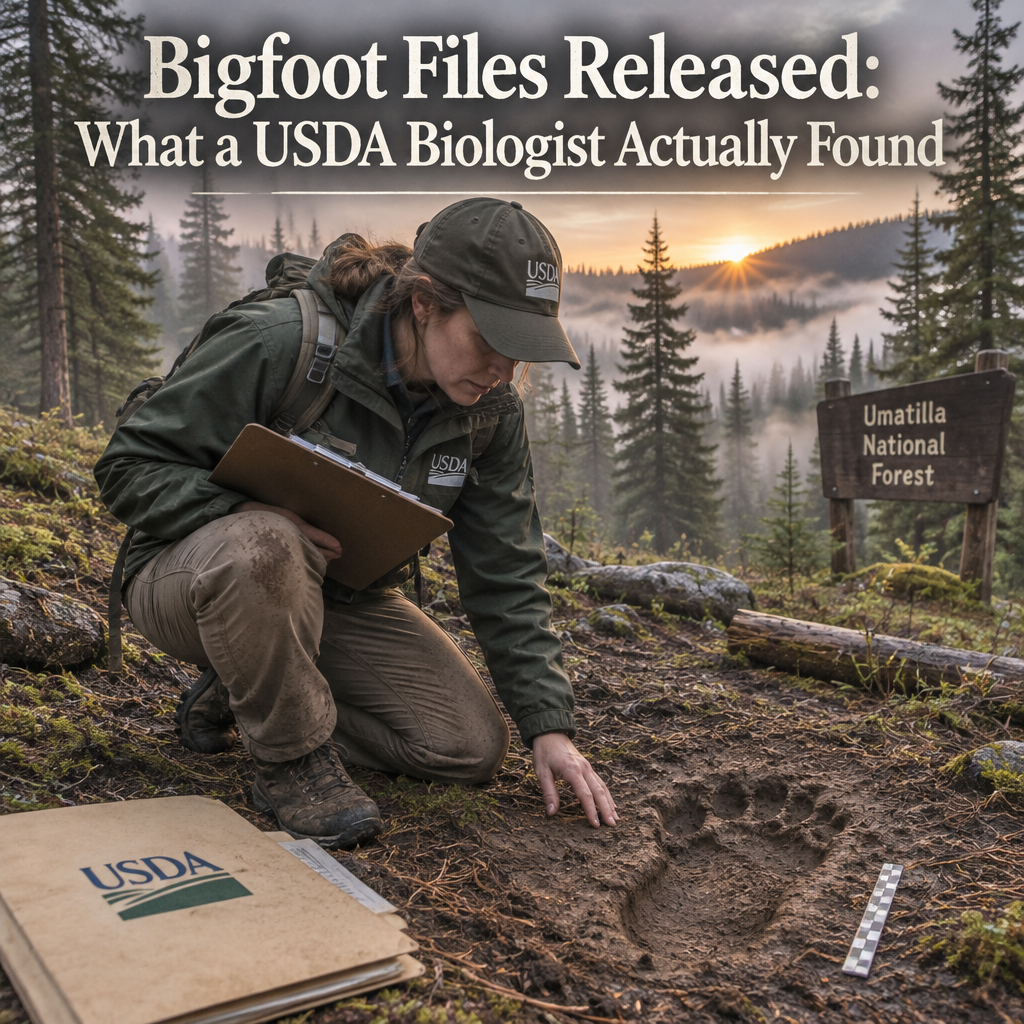
The “Bigfoot/Sasquatch Records” are three government files released by the U.S. Forest Service. Their most discussed item is a six-page memo written by Rodney L. Johnson, a biologist recruited by the U.S. Department of Agriculture in 1982 to inspect several locations where large footprints had been reported. The assignment concerned tracks in the Umatilla National Forest, an area of forestland that spans parts of Oregon and Washington.
Bigfoot, also called Sasquatch, is the name commonly given to a large, hairy, human-like creature said to live in remote forests in North America. Stories about such a being have circulated for generations, and the subject has become part folklore, part popular entertainment, and part recurring argument about what counts as convincing evidence. The encyclopedia entry on Bigfoot’s history and cultural reputation provides a useful overview, but cultural familiarity is not biological confirmation.
The Forest Service’s record release matters because it puts an actual government assessment in public view. That sounds dramatic. It needs a little restraint.
A federal agency having a file about a claim does not mean the agency verified the claim. In this case, the account describes a limited field examination: Johnson visited locations, looked at tracks, photographed them, and wrote down his assessment. The records do not amount to a continuing federal research program or a declaration that a new animal exists. Readers can consult the Forest Service’s Bigfoot/Sasquatch records page for the released material and the agency’s presentation of it.
Johnson’s wording is important. At Sites A and B, he concluded that the tracks were made by “something other than a 300-pound-plus two-footed being.” That is a judgment about the tracks he examined, not a sweeping proof that no unknown animal could exist anywhere. He also wrote that if the prints had been faked, someone had taken considerable care, and he remarked on marks and creases that appeared natural.
Here’s the kicker: those observations leave room for uncertainty, but uncertainty is not a secret confirmation. The memo records an expert’s attempt to assess physical impressions under the conditions available to him. It does not identify a maker, establish a species, or supply a final answer. It is a primary record of investigation, not the final chapter of the Bigfoot debate.
Core Details and Context
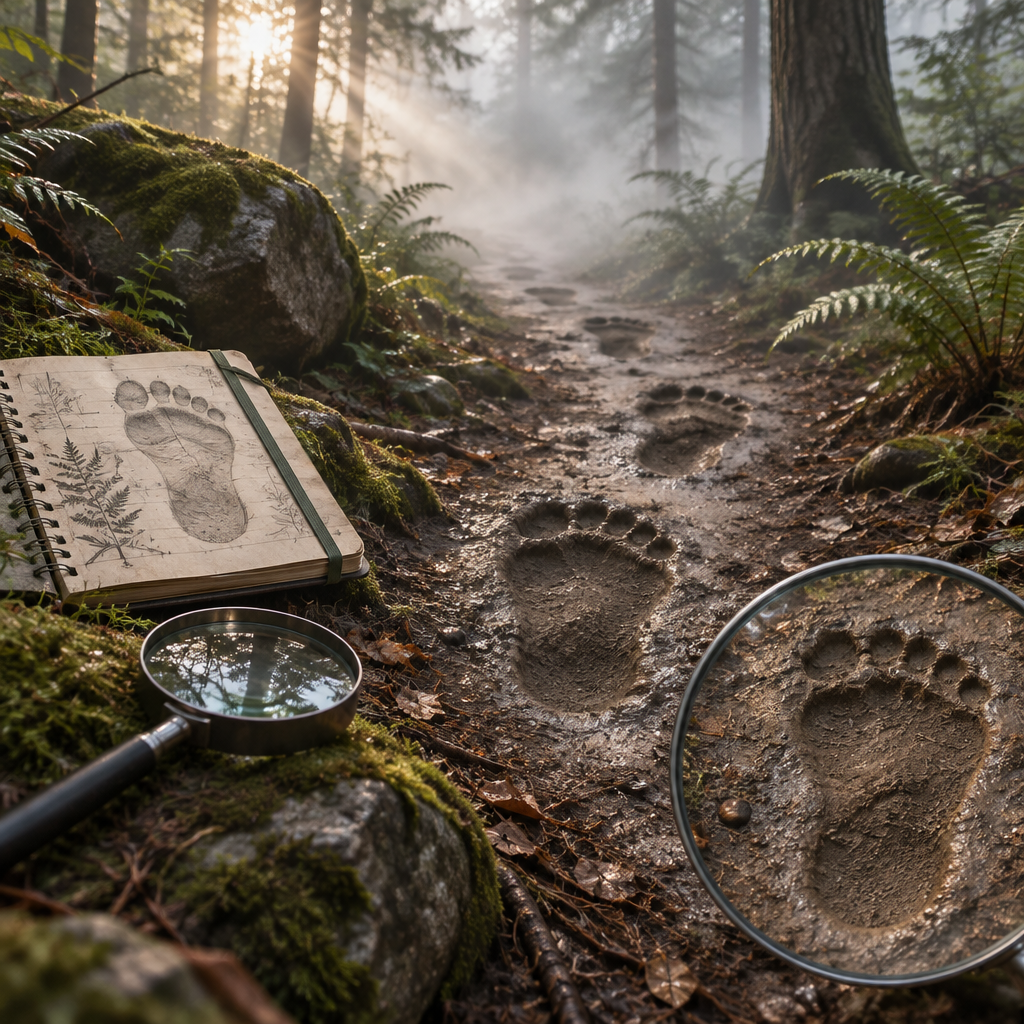
The files are compelling in part because they contain specific observations rather than a dramatic announcement. Johnson went to three locations and documented what he saw. His notes describe muddy trails at Sites A and B, where he photographed the tracks, and a dry, open area at Site C, where he observed 12 tracks similar to those at the other locations.
The main details are these:
- The assessment took place in 1982. Johnson was recruited by the USDA as a biologist to examine reported Bigfoot tracks. That makes his memo a contemporaneous field document, not a later retelling of an old story.
- Sites A and B were on muddy trails. Johnson photographed the impressions there. Mud can preserve shapes and surface marks, but it can also distort outlines, especially when a track is stepped on, altered, or exposed to changing conditions.
- He did not accept the tracks as evidence of a giant biped. His conclusion was that the Site A and Site B tracks came from something other than the 300-pound-plus, two-footed being described in the claim.
- He did not simply call the prints crude fakes. Johnson said that, if they were faked, someone had taken considerable effort. He also described some marks as appearing natural and difficult to duplicate.
- Site C added another set of impressions. Johnson recorded 12 tracks in a dry, open area and said they resembled those at Sites A and B. Similarity is worth noting, but it does not by itself establish a shared biological source.
The detail that attracts the most attention is Johnson’s discussion of the foot marks. He wrote that the “print” marks would be very hard to duplicate and appeared natural. He also considered whether a cast from an actual foot might have been used to make a fake, while noting that other creases should then have appeared. That is careful reasoning, not a verdict. A possibility raised in a memo is not proof that the possibility happened.
The account of the release does not report DNA testing, a recovered body, a verified hair sample, or an independently confirmed trail-camera image. That absence does not automatically disprove Bigfoot; it does limit what this particular set of records can establish. The proper claim is modest: Johnson examined unusual-looking tracks and found aspects of them difficult to explain, while deciding that the Site A and Site B tracks did not fit the large bipedal creature described to him.
I find that distinction more useful than the usual fight between believers and debunkers. A footprint is evidence of a footprint. Its shape may support questions about a maker, but a serious identification needs more than an intriguing outline and a compelling story. People who report unusual experiences deserve basic fairness, too; a person is more than a headline, and skepticism need not turn into ridicule.
Timeline: What Happened, Step by Step
- A report brings the tracks to official attention. In 1982, large footprints attributed to Bigfoot were reported at several locations in the Umatilla National Forest area. The claim was unusual, but an unusual claim can still be inspected. That is what Johnson was asked to do.
- The USDA recruits biologist Rodney L. Johnson. His role was to examine the reported tracks, rather than to announce whether Bigfoot existed across North America. That difference matters. A field visit to several sites is not a continent-wide survey, and the scope of the work should not be inflated after the fact.
- Johnson visits Sites A, B, and C. He found tracks mainly on muddy trails at Sites A and B and photographed them. At Site C, in a dry open area, he counted 12 tracks that he considered similar to those at the first two sites. The written account does not provide enough detail to reconstruct every condition at each site, so claims beyond the memo should be treated cautiously.
- He writes a six-page memo. Johnson assessed the Site A and Site B tracks as made by something other than a 300-pound-plus, two-footed being. At the same time, he remarked that the apparent natural marks would be hard to reproduce and that a faker would have needed to take considerable care. He did not name a maker or report a conclusive test that settled the matter.
- The Forest Service later releases three files. The records appear publicly under the title “Bigfoot/Sasquatch Records.” The release gives readers access to a government document that had not been part of everyday public discussion. The account does not specify the exact date of the release, so there is no need to invent one.
When I follow the sequence, the distinction between the 1982 work and the later release stands out. The Forest Service did not suddenly discover tracks or dispatch a new team; it released records of an earlier examination. The new public interest is about access to the files, not a new physical discovery in the woods.
That distinction is easy to lose when headlines compress the story into “government releases Bigfoot files.” The phrase sounds like a dramatic disclosure. The actual sequence is less cinematic: a biologist assessed tracks, wrote a cautious memo, and the agency eventually made three records public. The memo’s uncertainty is not a hidden answer. It is the answer the document supports.

Bigfoot Hypothesis vs. Human-Made Tracks
The strongest comparison is not between Bigfoot and a rival celebrity story. It is between the Bigfoot explanation and the ordinary alternatives: a person, a deliberately made impression, an animal track altered by conditions, or some combination of factors. The memo raises questions about those alternatives without conclusively choosing one.
| Question | Bigfoot interpretation | Human-made or ordinary explanation | What Johnson’s memo supports |
|---|
| What made the tracks at Sites A and B? | A large, two-footed creature could account for a large bipedal print. | A person, a constructed print, or altered impressions could imitate an unusual track. | Johnson judged the tracks inconsistent with a 300-pound-plus, two-footed being, but did not identify their maker. |
| Why did some marks look natural? | A believer may see natural-looking detail as a sign of a real foot. | A careful maker could create or preserve convincing detail; natural appearance alone does not establish origin. | Johnson said some marks appeared natural and would be difficult to duplicate. He did not say that this proved they came from Sasquatch. |
| Do the three sites confirm one source? | Similar impressions at three locations might suggest a recurring animal. | Similarity can result from similar methods, conditions, or misinterpretation. | Johnson described Site C’s 12 tracks as similar to those at Sites A and B. Similarity is not identification. |
| Does the release settle the debate? | Some may treat official records as indirect validation. | A government file can document an inquiry without confirming the claim. | The files preserve a field assessment; they do not establish Bigfoot’s existence or a hoax. |
The table is less satisfying than a yes-or-no answer. It is also more honest.
Johnson’s statement that a fake would have required “a great deal of trouble and detail” does not prove that a fake was made. Nor does his comment that the prints looked natural prove they came from a living creature. Both observations describe the difficulty of interpretation. They do not supply an identity.
The competing explanations also need to be treated with equal care. Calling the prints fake without evidence about who made them is as premature as calling them Bigfoot tracks without a verified specimen. One claim goes beyond the memo in one direction; the other goes beyond it in the opposite direction. Neither gains authority just by sounding confident.
The Forest Service’s description of the Umatilla National Forest helps establish the setting, not the answer. Its official Umatilla National Forest page provides information about the forest area, but a forest’s size and remoteness cannot identify a footprint’s source. Wilderness makes a good backdrop for a mystery. It is not evidence by itself.
For a firm biological identification, researchers would ordinarily want material that can be independently examined and tied to a clear chain of custody: a specimen, reliable genetic material, or another repeatable line of evidence. The account of Johnson’s memo does not report such findings. That means the files are historically interesting and scientifically limited at the same time.
Common Misconceptions: What to Know
Misconception one: the files prove the government knows Bigfoot is real. They do not. They show that a USDA biologist was asked to inspect reported tracks and that the Forest Service later released three records. Government paperwork records actions and observations; it does not turn every claim in a file into an official fact. A file about a report is not the same thing as confirmation of the report.
Misconception two: Johnson proved the tracks were fake. That overstates his conclusion. He said the Site A and Site B tracks were made by something other than the large, two-footed being described in the claim. He also acknowledged features that would make a fake difficult to produce. The account does not say that he identified a prankster, found a mold, or documented a deliberate hoax. “Not Bigfoot, as described” and “definitely a hoax” are different conclusions.
Misconception three: natural-looking marks are biological proof. They are not. A mark can look natural without revealing how it was made. Johnson’s comments about the “print” marks and creases show that he considered the detail, but the memo’s account does not report a test that tied those impressions to a known animal or an unknown one. Close observation is valuable; it is not a substitute for identification.
Misconception four: three sites mean three independent confirmations. The number of sites matters, but only if the observations can be independently evaluated and linked to a reliable source. Johnson found similar tracks at Site C, but the available account does not establish that each site represented a separate encounter with the same creature. Similarity can prompt further inquiry. It cannot settle provenance on its own.
Misconception five: an inconclusive result secretly favors one side. It may frustrate both sides, but it is not a coded endorsement. When evidence cannot identify a maker, the responsible answer is that the maker remains unknown. That is not evasive; it is a boundary around what the record can support. Let’s be real: a mystery is not solved merely because one explanation feels more exciting.
There is another point worth keeping in view. Public fascination can turn witnesses, biologists, and agency staff into characters in a culture-war skit: genius or fool, believer or liar, cover-up artist or spoiler. The memo does not justify those labels. Charity in judgment is compatible with a hard look at evidence. Human dignity does not require accepting every claim, and skepticism does not require sneering at the people who make one.
The files are best read as a small historical record with a stubbornly limited result. Johnson’s observations are specific enough to be interesting, but they stop short of proof. That may not satisfy fans looking for a reveal or skeptics looking for a clean debunking. It is still the fair reading.
Frequently Asked Questions
Did the Forest Service confirm that Bigfoot exists?
No. The Forest Service released three records concerning reported Bigfoot tracks, including Johnson’s 1982 memo. The document records a field assessment; it does not confirm Sasquatch as a real animal. The release of a government record should not be confused with a government finding that the claim is true.
What did biologist Rodney L. Johnson conclude?
Johnson concluded that the tracks he examined at Sites A and B were made by “something other than a 300-pound-plus two-footed being.” He also wrote that the marks looked natural and would be difficult to duplicate, and that a fake would have required considerable care. His comments do not identify who or what made the tracks.
What did Johnson find at Site C?
He reported 12 tracks in a dry, open area and said they were similar to those found at Sites A and B. That observation links the sites in his account, but it does not prove that the same creature made every set of prints. The reported findings do not establish an identified source for the tracks.
Do the released files prove the tracks were a hoax?
No. Johnson’s assessment weighs against the specific large bipedal explanation he was asked to consider, but the account does not report that he identified a person responsible for faking the tracks. The most accurate answer is that the files leave the maker unresolved. They add context, not a conclusive verdict.
Final Thought
The headline version of this story invites a choice: Bigfoot is real, or the whole thing was a prank. Johnson’s memo offers a less theatrical answer. He examined the tracks, judged that the Site A and Site B impressions did not come from the giant two-footed being described to him, and still noted details that made a simple fake harder to explain. That mixture is why the file remains readable decades later.
The records do not close the case. They do sharpen the question.
A responsible reader can hold two ideas at once: the tracks were unusual enough to merit examination, and the examination did not prove a new animal existed. That is not fence-sitting. It is a basic rule of evidence. Claims should not outrun the observations, whether the claim is a forest giant or a confident accusation of fraud.
I would file this as an intriguing government record, not a revelation. Johnson’s memo gets us closer to understanding what one biologist saw and thought in 1982; it does not tell us what made every print. Until better evidence arrives, the Bigfoot debate remains where the memo leaves it: open, unsettled, and best approached with curiosity, skepticism, and a little humility.
Sources