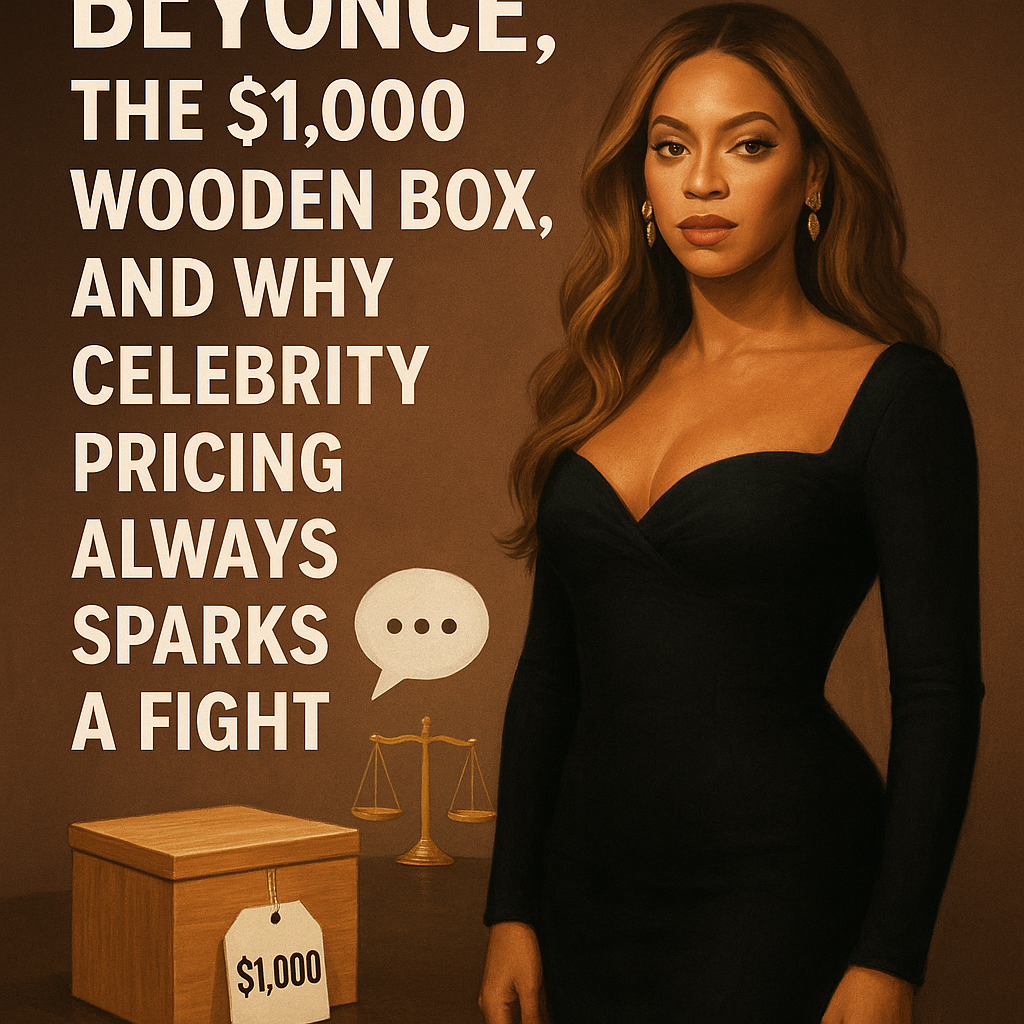
Beyoncé got dragged for it. A plain wooden box, priced at $1,000, set off the usual online pile-on, with critics calling it ridiculous and fans insisting...
Beyoncé got dragged for it. A plain wooden box, priced at $1,000, set off the usual online pile-on, with critics calling it ridiculous and fans insisting there had to be a hidden meaning, a secret track, or some other piece of carefully packaged theater. Frankly, the story says less about the box than it does about celebrity culture, pricing outrage, and how fast people confuse merch with moral failure.
Key Takeaways- A $1,000 wooden box tied to Beyoncé triggered backlash because the item looked minimal for the price.
- Social media split into two camps: people calling it absurd, and others guessing it hid an Easter egg or collectible value.
- The episode is part of a larger pattern in celebrity commerce, where scarcity, symbolism, and fan loyalty collide.
- The real issue is not wood versus luxury, but how much public image shapes what people think something is worth.
- When I track these flare-ups, I usually find the same thing: people are not only buying an object, they are buying a story.
What is Beyoncé’s $1,000 wooden box controversy?
It is a pricing scandal, not a legal scandal. The box itself became the subject because it looked stark, unfinished, and, to many viewers, offensively simple for the money asked. Yet celebrity merchandise rarely sells only the object in front of you. It sells access, symbolism, and the warm little lie that owning a thing makes you closer to the person behind it. That is the whole racket, and everyone knows it.
The Beyoncé box case fits neatly into the wider world of celebrity news, where every product drop is treated like a cultural verdict. One crowd sees an overpriced box. Another sees a limited-edition artifact attached to a global icon. Both reactions are predictable. Most public outrage starts with a photo, not facts, and then runs wild on its own fumes.
I’ve covered enough celebrity messes to say this plainly: fans and critics often talk past each other. The critic wants value for money. The fan wants meaning, rarity, and a bit of pageantry. One side talks like a shopper. The other side talks like a devotee. Neither is fully wrong, which is why these stories keep humming. Human beings are odd that way; we crave beauty and belonging, but we also want not to be fleeced.
That tension matters. A celebrity like Beyoncé is not selling a box in the same way a hardware store sells a box. She is selling association with status, artistry, scarcity, and a tightly managed public image. When the price looks detached from material value, people bristle. When the product seems to imply “you should feel lucky to pay this,” people get mean. And yes, some of that meanness is just performance for the feed.
For readers who follow celebrity merch scandals, this is the same basic engine you see in other pop-culture blowups. It resembles the backlash around extravagant limited drops, just with a different face on the packaging. If you want a useful comparison point, look at how fandom and controversy collide in stories like TMZ coverage, or at how celebrity reputations are framed in broader entertainment reporting from Billboard and Rolling Stone. The object changes; the outrage script barely does.
And here’s the kicker. The public often assumes that because something is expensive, it must be stupid. That’s too easy. Sometimes it is stupid. Sometimes it is a brand move. Sometimes it is both. The truth is, people rarely buy luxury items on logic alone, and celebrities know it. They sell emotion dressed up as exclusivity, then act surprised when folks complain.
Core Details and Context
The reaction came fast. Social media users mocked the box’s plain look, the material, and the idea that a wooden container could command a four-figure price. Others pushed back, saying fans buy into celebrity drops for the symbolism, not the lumber. That split tells you everything.
What people complained about:
- The box appeared simple and possibly even unfinished.
- The $1,000 price tag looked disconnected from the physical product.
- Critics framed it as an example of celebrity excess.
- Some argued the drop was engineered for viral attention rather than utility.
What defenders argued:
- The box may be part of a limited release or special collectible.
- It may contain an artifact, insert, or coded reference that justifies the price to collectors.
- Fans often pay for rarity and association, not just materials.
- In celebrity commerce, perceived meaning can outrank practical use.
Let’s be real: both sides have a point, though not equally strong ones. If the box is just a box, the criticism lands hard. If it holds something rare, the value changes. But unless the maker explains the product clearly, the public will fill in the blanks with suspicion. That’s what people do when transparency is thin.
This is also where business meets gossip. The product may be real, but the reaction is fueled by rumor. A few posts become a dogpile, then the dogpile becomes “proof” of a scandal. Most of the time, there is no scandal in the legal sense. There is only bad optics and a hungry internet.
There is also the matter of celebrity pricing psychology. Luxury brands have long charged for mystique. That is not new. What is new is the speed at which fans can publish side-by-side comparisons, call something “absurd,” and make the clip travel in minutes. The box may be expensive, but outrage is cheap and abundant.
When I analyze stories like this, I look for three things: the object, the explanation, and the audience reaction. The object may be modest. The explanation may be missing. The audience, meanwhile, supplies moral theater. That is why the same story can be read as elitism, art, trolling, or collector bait. People see what they already believe.
There is a deeper point too. Celebrity culture can flatten a person into a brand logo, but no person is only a brand. Catholic thought has a boring but useful habit of reminding us that human beings carry dignity even when their choices are flawed or showy. That does not excuse bad pricing or silly marketing. It just keeps us from pretending someone is a cartoon villain because they sold a box badly.
For readers interested in how celebrity image and media attention keep feeding each other, see related coverage on Vogue for the fashion-and-status angle and BBC Entertainment & Arts for the broader media framing. The pattern is plain enough once you stop gawking.
Timeline and Step-by-Step
This kind of story follows a familiar path. No magic. Just marketing, reaction, and a dash of chaos.
- Product appears or is noticed. A fan page, store listing, or social post surfaces the item, and the first reaction is usually a shrug or a squint. Is that really what I think it is?
- Price becomes the headline. Once people see the dollar amount, the item stops being an object and becomes an argument, because the number is what makes the blood pressure rise.
- Social media piles on. Critics post jokes, side-by-side comparisons, and screenshots, while defenders insist there must be hidden value or some artistic point. Frankly, the comments section never met a nuance it liked.
- Speculation kicks in. Users begin guessing about secret inserts, Easter eggs, collectible links, or symbolic meaning, and now the story has the texture of a scavenger hunt, whether or not that was intended.
- Brand silence or clarification. If the company or celebrity says nothing, the silence itself becomes part of the story; if they explain, the explanation is judged against the public mood, which is not always fair.
- The story hardens into a lesson. The box stops being a box and starts standing in for celebrity greed, fan loyalty, or the absurdity of luxury culture, which is how one product becomes a morality play by lunch.
I’ve seen this loop over and over. A questionable product drops. People laugh. Fans defend. Then everyone pretends the real issue was never the thing itself, but the principle. Sometimes that is true. Often it is a bit of both.
What actually happened here, from a media-analysis angle, is simple: a high-profile name plus an eye-catching price created friction, and friction creates traffic. That is the whole machine. You do not need a conspiracy to explain it. Just attention economics and a public that loves a target.
The timeline also helps explain why the conversation became less about craftsmanship and more about public image. Once a celebrity product becomes a meme, the details matter less than the symbol. That is why these stories keep coming back in entertainment coverage, from music merch to movie tie-ins to sports collectibles.
If you want a cleaner read on how celebrity stunts and public reactions overlap, compare this to coverage of high-profile branding moves in Forbes and entertainment analysis in The New York Times Arts section. Different outlets, same basic question: what are people actually paying for?
Comparison Table
Here is the useful comparison. Not the noisy one.
| Factor | Beyoncé Wooden Box | Typical Luxury Brand Box | Why It Matters |
|---|
| Brand pull | Extremely high | High | Celebrity name inflates perceived value |
| Material value | Low, based on appearance | Varies | Materials alone do not justify luxury pricing |
| Fan emotion | Very strong | Moderate to strong | Fans buy identity, not just goods |
| Media attention | Massive | Moderate | Viral backlash boosts visibility |
| Suspicion of gimmick | High | Moderate | Simple design invites criticism |
| Collector appeal | Possible | Often established | Scarcity can change the equation |
| Public trust | Mixed | Mixed | Clarity matters more than hype |
The table shows the real issue. The celebrity name does the heavy lifting, and that is both the asset and the liability. If the box is tied to a release with a special insert, then the value conversation changes. If it is just a plain wooden container, the backlash is earned. No amount of fan devotion can make a flimsy explanation sound noble.
A bigger competitor in this story is not another box. It is the whole luxury merch playbook. Fashion houses, musicians, athletes, and even political figures use scarcity to create desire. The difference is that stars with larger followings generate stronger emotions, which means stronger backlash when the product seems thin.
That is why I keep saying people should separate artistry from pricing. Beyoncé’s career, awards, and cultural influence are not in question. The merch question is narrower: does the object justify the ask? That distinction gets lost fast when a star is so huge that even a joke about a box feels like a referendum on the whole empire.
A small but important note: criticism should stay honest. Mock the pricing if it looks silly. Fine. But do not pretend an expensive drop equals proof of moral corruption. That is lazy. Public figures are not saints, but they are not disposable idols either. A little charity in judgment goes farther than online sneering.
For another angle on celebrity branding, see Elle Fashion and The Hollywood Reporter. These stories often reveal how much of the argument is about image management, not the item itself.
Common Misconceptions and What to Know
The internet loves a neat story. Usually too neat.
Misconception 1: “It’s just a box, so the price is automatically a scam.”
Not always. In celebrity commerce, the box may function as packaging, collectible art, or part of a larger limited release. Still, if the explanation is weak, people have every right to object. A high price without context is a fast track to ridicule.
Misconception 2: “If fans buy it, criticism is invalid.”
Wrong. Fans can love an artist and still question the product. Loyalty does not cancel common sense. That would be silly. The better question is whether the item’s value is clearly communicated.
Misconception 3: “All outrage is fake.”
Also wrong. Some people are genuinely offended by celebrity excess, especially when money is tight and essentials cost more every year. Their irritation may be amplified online, but that does not make it fake.
Misconception 4: “If there’s an Easter egg, the price is automatically justified.”
Not so fast. Hidden meaning can add collector appeal, but it does not perform miracles. A secret insert is still not a clean excuse for sloppy presentation or poor messaging.
Here’s the truth: most celebrity controversies are really arguments about fairness, status, and trust. That is why they travel so far. People are not only judging the object; they are judging the person’s motives. Sometimes they go too far. Sometimes they are right on the money.
I’ve noticed that the loudest reactions often come from people who do not want the celebrity to be a human being with ordinary market decisions. They want a symbol to attack. But a public figure, like any person, has both gifts and blind spots. That is the old story, and it never gets less true.
You also have to watch for media distortion. A viral post can make an object seem more central than it is. A narrow merch issue can swell into a full-blown culture war. Before long, everybody is talking as if the box were a political document. It is not. It is a product, and maybe a clumsy one.
If you want broader context on celebrity image cycles, the reporting styles at AP News and Reuters are useful because they strip away a lot of the glitter and focus on what was actually said or sold.
Frequently Asked Questions
Why did people react so strongly to Beyoncé’s wooden box?
Because the price looked wildly out of step with the item’s simplicity, and social media is built to turn that kind of mismatch into a spectacle.
Could the box contain something valuable?
Possibly. Fans speculated that the box could include a collectible item or hidden Easter egg, but without a clear official explanation, that remains speculation.
Is this kind of backlash common in celebrity news?
Absolutely. High-profile names often trigger debate over pricing, exclusivity, and whether a product is art, merch, or just a stunt.
Does celebrity merch always deserve criticism?
No. Some celebrity merchandise is well-made and genuinely collectible. But when the object looks bare and the price is steep, people are entitled to ask hard questions.
Final Thought
This story is small and revealing. That’s all.
A wooden box at a thousand bucks is not a world-shaker, but it does expose how celebrity culture works: the name matters, the object matters less, and the public will argue for days over whether they are buying art, access, or a polished bit of nonsense. My read is simple. Most outrage is exaggerated, but not all of it is foolish, and the line between collectible and con is thinner than the glossy posts suggest.
What I keep coming back to is this: fame can magnify beauty, talent, and craft, but it can also magnify silliness. The same public that admires a star’s gifts will roast a bad product in the next breath. Fair enough. Yet even here, the person is bigger than the stunt. That is a basic human truth, and it is worth remembering before the pile-on gets nasty. People are not just brands, and they are not just prices. They are frail, gifted, contradictory beings, which is why the internet finds them so easy to flatten.
If the box had meaning, the brand should have said so clearly. If it was a collector’s item, explain the value. If it was a marketing tease, own the tease. Confusion breeds contempt. Clarity usually saves everyone a headache. Or at least cuts down the nonsense.