Beau Jessup, Lisa Maxwell’s Daughter, Dies at 27: What Is Known
Beau Jessup, the 27-year-old daughter of The Bill actor Lisa Maxwell, has died, Columbia University announced on Wednesday. Jessup was studying for a master’s degree in journalism at Columbia and was expected to graduate in May 2027. The university did not disclose a cause of death.
The confirmed details are few, but they tell us something about how Jessup hoped to work: she wanted to report on people, culture, and the forces that shape daily life. In the interview Columbia released, she described an interest in who gets to tell people’s stories—and what can happen when those stories become public. That concern feels especially relevant now, as news of her death travels through the same media channels she had hoped to understand and use carefully.
The university’s statement was brief. It expressed sympathy for those who knew and loved her, without offering private details. That restraint matters. A death involving a public figure’s family can attract attention quickly, but attention is not permission to fill in what has not been reported. The facts deserve to be shared; the unknowns deserve to remain unknown unless her family or the university chooses otherwise.
What Is Known About Beau Jessup?
Beau Jessup was a 27-year-old graduate student at Columbia University’s M.S. Journalism program and the daughter of British television actress Lisa Maxwell, known for her work on The Bill. Columbia announced her death on Wednesday through its public channels, according to the reported account, and shared a statement of condolence for Jessup’s family, friends, classmates, and everyone who knew her. The university did not disclose how she died.
Jessup was close to completing her degree. The reported account said she was six months away from graduating in May 2027. Columbia also published an interview with her that had been conducted the previous month for its Notebook series. It offered a glimpse of her intellectual interests, not a full biography—and it should be read as that, rather than as a complete account of a young woman’s life.
She described an interest in cultural journalism, particularly the ways institutions, identity, and social expectations affect how people live and understand one another. Her earlier studies included social anthropology at the London School of Economics and writing for performance at the University of Cambridge. She also had a connection to theatre: she wrote her first play, The Sandbag, while studying at Cambridge. After graduation, she hoped to report on people, culture, and social questions.
The most revealing passage in the interview concerned her awareness of the distance between a person’s lived experience and the public stories told about that person. “As the daughter of a television actress,” she said, she had noticed that gap from an early age. She understood that journalism could illuminate people’s lives, but could also simplify or distort them.
That is a useful frame for covering her death. Jessup was related to a well-known actress, but her own studies, writing, and ambitions were distinct. Columbia’s journalism program is described on the school’s official website; the public information here, however, should not be stretched beyond what the university and the reported interview actually establish. She was a student with her own interests and plans—not merely a footnote to a celebrity biography.
Core Details and Context
The public account gives readers a small set of reliable details. Those details are meaningful, but they are not an invitation to speculate. Here is what can be stated plainly:
- Age: Jessup was 27.
- Family connection: She was the daughter of actor Lisa Maxwell, associated with the British television series The Bill.
- Education: She was pursuing an M.S. in Journalism at Columbia University in New York City.
- Expected graduation: The account said she was six months from completing the degree, with graduation expected in May 2027.
- Academic interests: She was drawn to cultural journalism and the relationship between institutions, identity, social expectations, and everyday life.
- Earlier studies: She studied social anthropology at the London School of Economics and writing for performance at the University of Cambridge.
- Creative work: She wrote a first play, The Sandbag, while at Cambridge.
- Cause of death: Columbia did not disclose one in the reported statement.
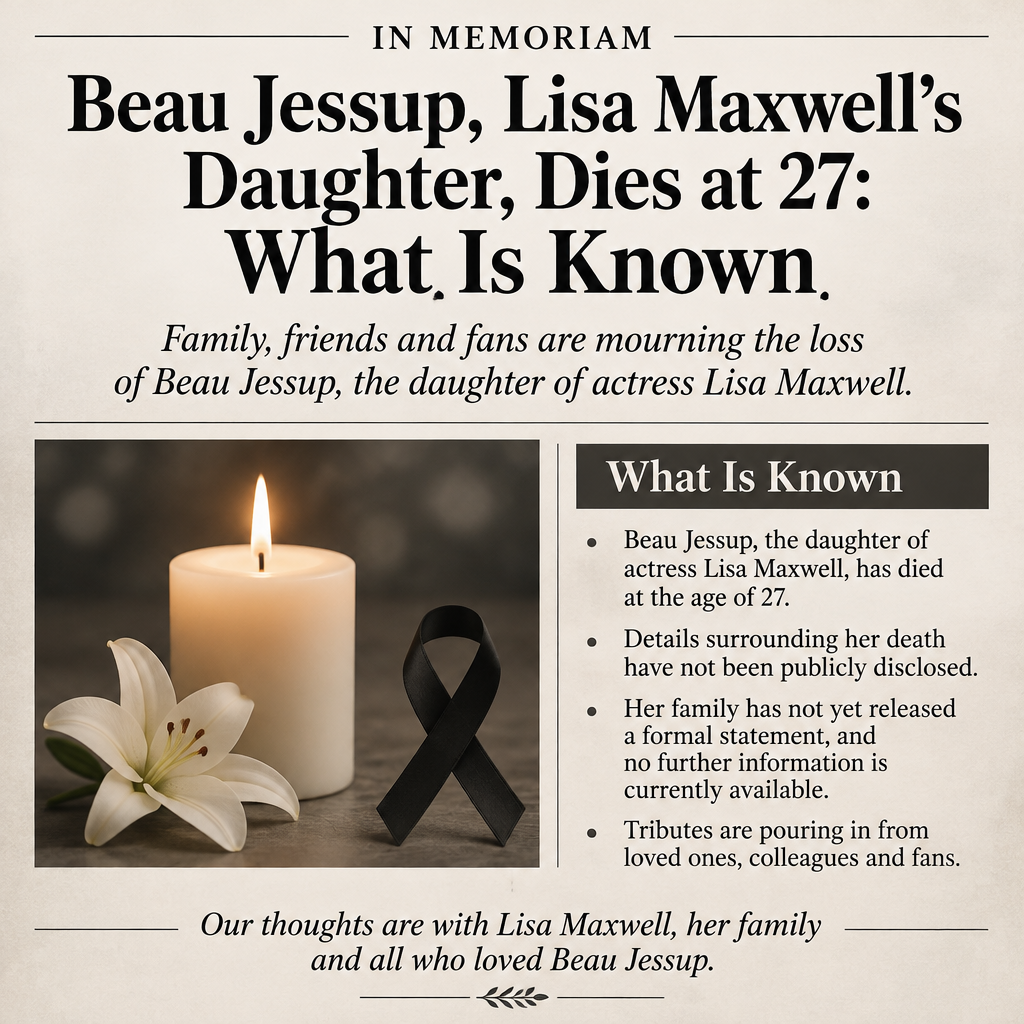
The university’s words were direct: “We extend our deepest condolences to her family, friends, classmates and all who knew and loved her.” The statement recognized a circle of people grieving beyond the family alone. Classmates and friends are not background characters in a news story; they are people facing a loss in private while public attention gathers around it.
The interview adds context without resolving the central question readers may have. It was conducted as part of Columbia’s Notebook series the month before the announcement, then released by the university after Jessup died. Its publication gives the public her own words about journalism and storytelling. It does not establish the circumstances of her death, and it should not be treated as a coded explanation.
I find that distinction important. A recent interview can make a story feel unusually intimate, but it remains an interview about the topics discussed in it. Turning every line into a clue would mistake hindsight for evidence. Her reflections on public narratives deserve attention on their own terms—not as material for theories about an event the university did not explain.
There is also a broader responsibility here. A famous parent may make a family story more visible, but visibility does not cancel a person’s dignity or the privacy of those left behind. The Society of Professional Journalists’ Code of Ethics emphasizes minimizing harm and taking care with people affected by a story. That is not a call to suppress confirmed news. It is a reminder to report it without turning grief into spectacle.
Timeline: What Happened and What Was Reported
A short timeline helps separate the known sequence from the gaps. The account does not give a precise date for Jessup’s death or describe the circumstances, so neither should be supplied by guesswork.
- Before the announcement: Jessup studied social anthropology at the London School of Economics and writing for performance at the University of Cambridge. During her time at Cambridge, she wrote The Sandbag. These details come from the profile and interview described by Columbia; the account does not provide a year-by-year biography.
- Her journalism studies: Jessup enrolled in Columbia University’s M.S. Journalism program in New York City. She was interested in cultural journalism and in how social structures and identity shape people’s lives. Her remarks show a developing professional interest, not a claim that she had already built a public reporting career.
- The interview: The month before Columbia’s announcement, Jessup took part in an interview for the university’s Notebook series. She spoke about the way public accounts of people can differ from the experiences those people actually have. The university later made that interview public.
- Columbia’s announcement: On Wednesday, Columbia announced that Jessup had died at 27 and offered condolences to her family, friends, classmates, and loved ones. The school did not disclose a cause of death in the reported statement.
- The information available afterward: The public account described Jessup as six months from completing her degree, with graduation expected in May 2027. It also noted her aspirations to report on people, culture, and social questions. The account said Maxwell had not addressed her daughter’s death publicly at that time.
That sequence is enough to explain what has been reported. It is not enough to construct a fuller chronology of Jessup’s final days, and responsible coverage should not pretend otherwise. When I assess a story like this, I separate the dates and statements that are actually on record from the connective tissue a headline might encourage readers to imagine. Here, the restraint is the point: an unfinished public record is not a puzzle that outsiders are entitled to solve.
Comparison: Jessup’s Reported Story and Celebrity-News Framing
There is no meaningful “celebrity competitor” to compare with Jessup. She was an individual, not a product or a public brand competing for a market. The closest useful comparison is between the documented account of her life and the familiar celebrity-news framing that can turn a personal loss into a spectacle. The distinction is not about whether the news matters. It is about how accurately and humanely it is presented.
| Point of comparison | Documented account of Beau Jessup | Sensational celebrity-news framing |
|---|
| Main focus | A 27-year-old student, her interests, and Columbia’s announcement | A famous parent or a dramatic headline treated as the whole story |
| Confirmed details | Journalism studies, academic interests, theatre writing, age, and the university’s condolence statement | Details may be mixed with unsupported assumptions if reporting is careless |
| Cause of death | Not disclosed by Columbia in the reported statement | Speculation may be presented as though it were an answer |
| Jessup’s own words | Her concerns about identity, institutions, and who tells people’s stories | Quotes can be stripped of context or recast as clues |
| Public value | Records what is known while respecting the limits of the account | Pursues clicks by making uncertainty seem like a mystery to solve |
The first column is necessarily modest. That is a strength, not a failure. A careful report can acknowledge that an important fact is absent without dressing the gap up as intrigue. The Columbia Journalism School website provides context about the institution, while Columbia’s public journalism account is the kind of channel through which the university communicates with its community. Neither should be mistaken for permission to infer facts the school did not share.
Frankly, the urge to compare every public figure’s family story with another celebrity story is often a distraction. There is no evidence in the reported account of a rivalry, scandal, or competing narrative. The proper contrast is between reporting that stays with verifiable details and coverage that uses a person’s death as a hook for conjecture. In this case, the first approach is both more accurate and more humane.
Common Misconceptions and What to Know
Misconception: Columbia disclosed how Jessup died. The reported statement did not. No cause was provided, so claims assigning one should not be repeated as fact. “Unexpected death” describes how the news was characterized; it does not explain the medical, personal, or other circumstances. Those are separate questions, and the account answers none of them.
Misconception: Her mother’s fame tells us everything about Jessup’s life. It does not. Maxwell’s career is relevant background because Jessup herself spoke about growing up as the daughter of a television actress. But the interview also makes clear that Jessup had her own academic path, interests in cultural journalism, and creative work in theatre. Reducing her identity to a family connection would erase the very distinction she discussed: the gap between a person and the public story built around them.
Misconception: The interview contains clues about her death. Nothing in the reported account supports that reading. Jessup spoke about journalism, public narratives, identity, and culture. Those are subjects she cared about; they should not be retrofitted into an explanation of her death. A passage can feel newly poignant after a loss without becoming evidence about its cause.
Misconception: A lack of detail means something is being concealed. Not necessarily. A university may share condolences while leaving private matters to a family. The available account does not establish why further information was not provided. Guessing at motives adds noise, not knowledge.
Misconception: Public interest removes the need for care. It does not. There is a legitimate reason to report a student’s death when her university has made an announcement and her family connection has attracted public attention. But legitimate interest has limits. The Dart Center for Journalism and Trauma offers resources for reporting on grief and trauma; the general lesson is simple: accuracy and compassion belong in the same story.
Here’s the kicker: restraint can feel unsatisfying in a news cycle trained to expect a complete explanation at once. But the correct answer to an unanswered question is not a confident guess. It is a clear sentence saying the information has not been reported. People are more than their public image, and those who are grieving should not have to compete with a rumor mill for the last word on a private loss.
Frequently Asked Questions
Who was Beau Jessup?
Beau Jessup was the 27-year-old daughter of actor Lisa Maxwell and a graduate student in Columbia University’s M.S. Journalism program. Her interests included cultural journalism, and she had studied social anthropology at the London School of Economics and writing for performance at the University of Cambridge. She also wrote The Sandbag while studying at Cambridge.
What did Columbia University say?
Columbia announced Jessup’s death on Wednesday and expressed condolences to her family, friends, classmates, and everyone who knew and loved her. The university also released an unpublished interview with Jessup that had been conducted the previous month for its Notebook series.
What was Beau Jessup’s cause of death?
The reported Columbia statement did not disclose a cause of death. No explanation should be presented as confirmed unless the university or her family makes one public.
Was Beau Jessup close to graduating?
Yes. The reported account said she was six months from completing her master’s degree, with graduation expected in May 2027. She had described wanting to pursue reporting on people, culture, and social questions after graduation.
Final Thought
The most human part of this story may be the simplest: Columbia remembered Jessup as someone loved by family, friends, and classmates, while her own interview captured a student thinking carefully about other people’s lives. Her remarks about public storytelling now carry a particular weight, but they do not need to be treated as prophecy or turned into a final, tidy narrative. They can stand as the words of a young journalist-in-training describing what mattered to her.
The news is real. The loss is real. The missing details remain missing. That boundary is not a loophole for speculation; it is a line responsible coverage should hold. Maxwell has not addressed the death publicly, according to the account, and no one outside the family can know what kind of space they need right now. A pause is not indifference. Sometimes it is the clearest sign that a person’s dignity matters more than an audience’s appetite for detail.
Jessup once asked who gets to tell people’s stories when they enter public life. The question applies here, too. Reporters can name what is confirmed, quote her own words accurately, and recognize the plans she had for her work. They can also decline to invent an ending for facts that have not been shared. Charity in judgment does not mean avoiding the truth; it means refusing to make a grieving family pay for the limits of what the public knows.