Alanis Morissette Says She’s Pansexual: What She Actually Shared
Alanis Morissette publicly identified as pansexual during a Nov. 3 episode of the Handsome podcast, confirming the label after co-host Tig Notaro questioned her. The exchange was playful, but the statement was direct: Morissette said she is pansexual, then joked that she likes to save such revelations for the epilogue. It is a personal disclosure, not an invitation to guess at her private life.
The headline-friendly version is easy to write: famous singer, unexpected reveal, amusing podcast banter. The fuller version deserves more care. Morissette offered a clear answer, but she did not turn the conversation into a detailed account of her relationships, history, or private feelings. That boundary matters. Celebrity coverage often treats one sentence as permission to build a whole biography out of guesses; there is no need to do that here.
Her remark also arrives alongside renewed attention to her long career, a remembered Sex and the City appearance, and a reported legal dispute. Those stories are not interchangeable. When I separate what Morissette actually said from what headlines might imply, the central fact stays simple: she named her own identity, and the rest should not be filled in by speculation.
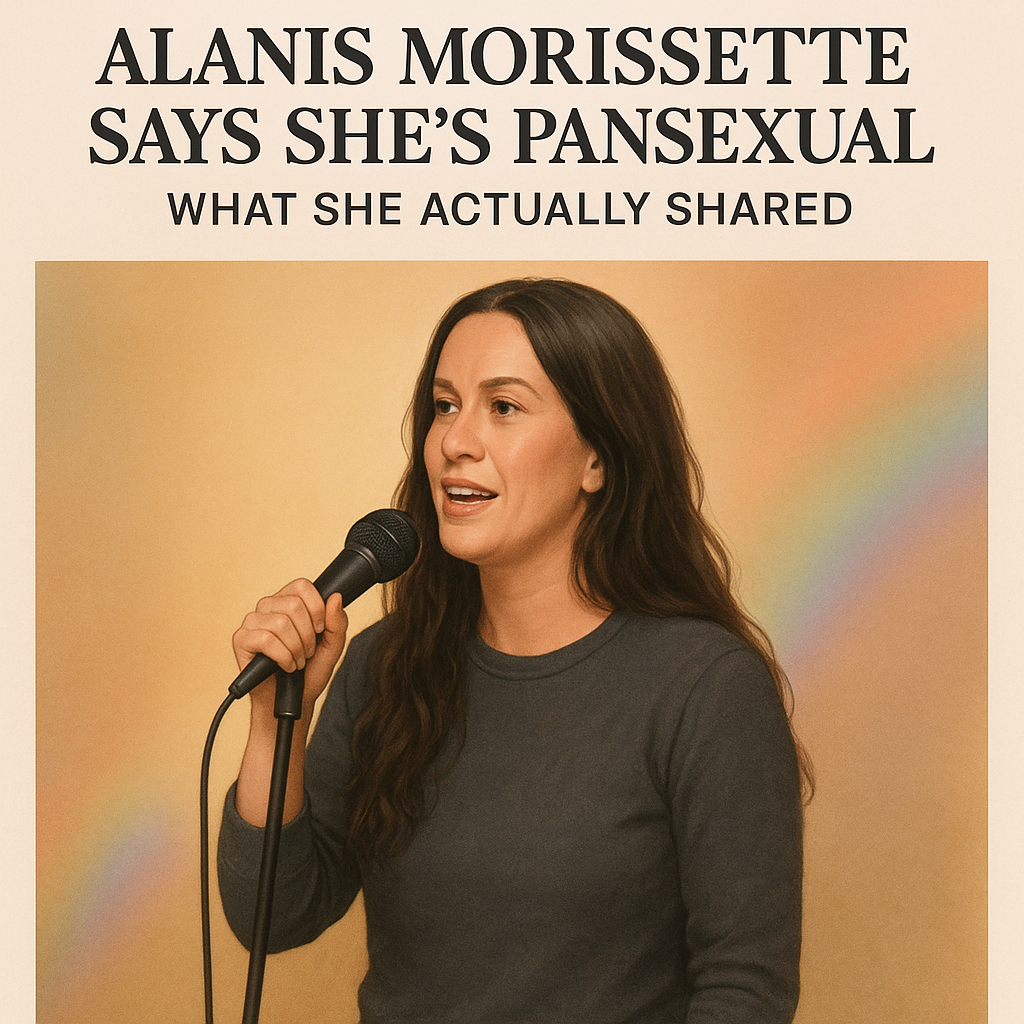
What Is Alanis Morissette Saying About Being Pansexual?
Morissette was asked a casual, slightly teasing question about whether painful experiences with men had ever made her want to be a lesbian. She replied, “I’m pansexual, so, yeah.” Notaro then asked whether she was really pansexual, and Morissette answered, “I am.” The hosts joked that she should have opened the episode with the news. Morissette responded that she liked to leave it for the epilogue.
That exchange is the public record of the conversation described here. It contains a clear self-identification, a follow-up confirmation, and a joke about timing. It does not contain a full statement about how Morissette understands her sexuality, when she first used the word for herself, or what she may or may not choose to share later. Those details have not been reported in this account, and there is no honest reason to invent them.
Pansexual is commonly used to describe romantic, emotional, or sexual attraction to people regardless of their gender. The word does not prescribe how often someone dates, what relationships they pursue, or whether they are attracted to every person they meet. People use identity terms in their own ways, and a concise definition cannot replace someone’s own account. The GLAAD reference guide provides terminology context; Morissette’s own words remain the authority on her identity.
Frankly, the important distinction is between describing a term and assigning one. A journalist, fan, co-host, or search engine cannot decide what label fits a person better than that person can. Morissette did not present her answer as a puzzle for audiences to solve. She stated it plainly, confirmed it when challenged, and moved on with the conversation.
That does not mean the subject is trivial. Public figures can face pressure to explain every personal detail as soon as they make one part of their lives public. But a person is more than a public image, and a short disclosure does not erase the right to privacy. Good coverage can note what was said without demanding a confession, a timeline, or a list of past partners. Let’s be real: curiosity is not the same thing as entitlement.
The Core Details: What Was Said, and What Was Not
The clip’s tone matters, but it should not drown out the words. Feimster expressed sympathy for the men who had hurt Morissette and said she was grateful those experiences had inspired songs. She then asked whether that had ever made Morissette want to be a lesbian. Morissette’s reply redirected the premise: she said she was pansexual. When Notaro queried whether she meant it, Morissette confirmed that she did.
The hosts’ surprise and joking response may explain why the moment traveled as entertainment news. It does not make the answer less direct. Nor does it give the audience grounds to decide that she was joking. Morissette made a joke about saving the news for the epilogue, not about whether she was pansexual. Those are different things, and mixing them up produces a misleading headline.
A few facts keep the story in proportion:
- The disclosure: Morissette identified herself as pansexual and affirmed that identification when asked again.
- The setting: The exchange occurred on Handsome, a podcast hosted by Tig Notaro, Fortune Feimster, and Mae Martin. The show’s official site is the appropriate place to check its own episode information.
- The tone: The hosts used humor, and Morissette joined in. Humor does not cancel the plain meaning of her answer.
- The limits: The exchange did not provide a relationship history, a coming-out timeline, or details about how she uses the label in private.
- The distinction: Her identity is not determined by whom she is married to, whom she has kissed on screen, or which songs became famous.
Her marriage to musician Mario “Souleye” Treadway, whom she married in 2010, does not contradict her statement. The couple have three children, as reported in coverage of Morissette’s family life. A current partner’s gender does not settle a person’s orientation, and it is not a public vote on whether an identity is valid. That point should be obvious, though celebrity coverage has a habit of treating relationship status as evidence in a courtroom that does not exist.
Here’s the kicker: audiences often ask for “proof” of an identity through a person’s dating history, while overlooking the simplest evidence available—the person’s own description. Morissette supplied that description herself. Nobody needs to infer it from a lyric, an old interview, a role on television, or the gender of her spouse.
The practical standard is basic: quote accurately, attribute the statement, and do not add claims she did not make. If she chooses to offer more detail, that becomes another story. Until then, the line between reporting and prying is not hard to see.
Timeline: The Podcast, the Kiss, and the Other Headlines
- The Handsome conversation. Near the end of the Nov. 3 episode, Feimster raised the subject of men who had hurt Morissette and asked whether the experience had ever made her want to be a lesbian. Morissette said she was pansexual. Notaro asked if she was serious; Morissette confirmed it. When the hosts said she could have started with that news, she joked that she preferred the epilogue. The sequence is short, but the distinction between her answer and the surrounding banter is worth keeping.
- The remembered Sex and the City scene. In a September appearance on Call Her Daddy, Morissette recalled kissing Sarah Jessica Parker during her guest appearance on Sex and the City around 2000. She said she had approached the show with the idea that Carrie might have a lesbian moment. Morissette described the kiss as pleasant, easy, and buoyant. That is her account of a scene and the way it came about; it is not a substitute for her later self-description.
- The career behind the headlines. Morissette rose to international fame with Jagged Little Pill, released in 1995. The album became one of the era’s defining records and cemented her public image as a songwriter whose work could be sharp, exposed, and emotionally direct. The Recording Academy’s artist profile documents her Grammy recognition, while the Songwriters Hall of Fame profile records her induction in 2022. The Broadway musical adapted from the album opened in 2019 and won two Tony Awards; the Tony Awards production page provides the show’s official award record.
- The separate legal filing. In September, Morissette took legal action against former tour manager Keren Urinov. Her lawsuit alleged that Urinov, described in the filing as a former employee, tried to extort her and threatened to frame her for drug trafficking after drugs were found in luggage during a European tour. Those are allegations made by Morissette in a lawsuit, not established facts or a court finding. The reported account does not give a final ruling, so the responsible description remains “alleged.”
I find the timeline useful because celebrity stories often get bundled into one giant narrative. A personal identity disclosure, a recollection of an on-screen kiss, a career milestone, and a lawsuit do not become one story just because they involve the same person. The dates and subjects differ. So do the standards for reporting them.
Comparison: Morissette’s Own Words Versus the Kiss Headline
The nearest competing frame is the older story about her kiss with Parker. Some coverage may place that anecdote beside the pansexual disclosure because both involve same-sex attraction or a same-sex moment. But they are not equivalent evidence. One is a remembered scene from an acting role; the other is Morissette’s direct statement about her identity.
| What readers may see compared | What the account supports | What it does not establish |
|---|
| Morissette’s Handsome statement | She said, “I’m pansexual,” and confirmed, “I am.” | A full personal history or a timeline of when she adopted the label. |
| The Sex and the City kiss | Morissette said she proposed the scene and recalled the kiss positively. | That an acting scene defines her sexuality, or that it explains her later disclosure. |
| Her marriage to Mario Treadway | They married in 2010 and have three children. | That her orientation is limited to the gender of her spouse. |
| The lawsuit involving Urinov | Morissette’s filing made allegations about attempted extortion and a threatened accusation. | That the allegations have been proven or that a court has reached a final decision. |
The table is not ranking these facts by importance. It is separating different kinds of evidence. Morissette’s own words are the clearest source for how she identifies. Her account of a scene describes that scene. A legal complaint describes claims a party has made. Confusing those categories makes a story louder, not more accurate.
There is also no meaningful “competitor” between a person’s orientation and a past performance. The better comparison is between two ways of framing a headline: one that quotes her self-identification and one that tries to make the old kiss do the explanatory work. The first is supported by her words. The second risks implying that a single onscreen moment is a clue to be decoded.
That temptation is understandable in a celebrity-news business built around callbacks and resurfaced clips. It is still a poor shortcut. A scene can be relevant background because Morissette discussed it herself, but it should not be used to manufacture a neat origin story. People are not plot twists whose earlier scenes must be retrofitted to make the ending tidy.
Common Misconceptions: What to Know Before Drawing Conclusions
“She said it as a joke, so it may not count.” The surrounding podcast exchange was humorous, and Morissette used a punchline about the epilogue. But she directly answered the question and confirmed her statement after Notaro asked whether she meant it. The joke was about when she shared the news. Treating the answer itself as ironic ignores the most direct part of the exchange.
“Being married to a man contradicts being pansexual.” It does not. A person’s orientation is not invalidated by the gender of a current or former partner. Morissette’s marriage to Treadway is a reported fact about her family life; it is not a counterargument to the label she chose. No one needs to audit a person’s relationship history to accept a self-identification.
“The kiss with Sarah Jessica Parker explains the announcement.” It explains a story about a television scene, including Morissette’s recollection that she proposed it. It does not explain why she identifies as pansexual or when she began using that term. That information was not reported in the conversation described here. Connecting the two as cause and effect would be guesswork dressed up as a narrative.
“A short public disclosure means the public gets all the details.” No. Morissette said what she said, and the available account does not report more. There is no obligation to provide a checklist of past relationships, private conversations, or personal milestones. Celebrity status brings public attention, not ownership of a person’s private life. People can be candid in one moment and still keep other parts of themselves to themselves.
The same care applies to the lawsuit. The filing reportedly accused Urinov of attempted extortion and threatening to implicate Morissette in drug trafficking. A complaint is one side’s claims in a legal dispute, not a verdict. Unless reliable reporting establishes a court outcome or a response from the other party, readers should not turn an accusation into a settled fact. That caution is not fence-sitting; it is the difference between reporting and repeating.
The larger lesson is ordinary but useful: public figures deserve accurate coverage, and accuracy includes limits. A sharp headline may win a click; a careful sentence earns trust. Charity in judgment does not require believing every claim. It does require resisting the urge to reduce a complicated person to one label, one lyric, one kiss, or one lawsuit.
Frequently Asked Questions
Did Alanis Morissette say she is pansexual?
Yes. During the Nov. 3 Handsome podcast episode, Morissette said, “I’m pansexual,” and confirmed that statement after Tig Notaro asked whether she was serious. She then joked that she liked to leave the news for the epilogue. The reported exchange does not include a longer explanation of her identity, so more detailed claims should not be attributed to her without a source.
What does pansexual mean?
Pansexual commonly describes romantic, emotional, or sexual attraction to people regardless of gender. People may use identity terms with personal nuance, and a definition is not a substitute for someone’s own account. Morissette used the word for herself; the public does not need to add conditions or demand a more elaborate explanation.
Is Alanis Morissette married, and does that change what she said?
Morissette married musician Mario “Souleye” Treadway in 2010, and they have three children. That relationship does not contradict her self-identification. A partner’s gender does not determine whether a person can be pansexual, and the public record of a marriage does not provide a complete account of anyone’s orientation.
Was the Sarah Jessica Parker kiss the same as Morissette’s disclosure?
No. Morissette recalled proposing and filming a same-sex kiss during her Sex and the City guest appearance, describing it positively in a separate interview. That anecdote concerns a television scene. Her pansexual statement on Handsome was a direct description of herself; one should not be treated as proof or explanation of the other.
Final Thought
Morissette did not bury the answer under a long speech. She named her identity, confirmed it, and kept the conversation moving. The hosts’ surprise gave the moment a comic rhythm, but the substance does not depend on whether the exchange became a viral clip or a headline. Her words are enough.
The surrounding facts are worth reporting when they add real context: her marriage, her work, her memory of a television scene, and the allegations in a legal filing. But each belongs in its own lane. A career achievement should not be reduced to gossip; a lawsuit should not be reported as a verdict; and a personal disclosure should not become a licence to speculate about intimate details. The distinction is simple. The discipline to keep it is less common.
I have covered enough celebrity stories to know that the loudest framing is rarely the most useful one. Here, the useful point is not that a famous person has suddenly become an object of public debate. It is that she described herself, and the description deserves to be taken at face value. People contain both strength and frailty, private complexity and public work. Respecting that complexity is not softness. It is good reporting.